

Warehouse Ceiling Fans Customized Manufacturer for Powerful Industrial Cooling
2026-11-03
When summer heat turns a warehouse into a productivity killer, standard ceiling fans simply won't cut it. That's where a customized approach makes all the difference—and VINDUSFAN has spent years perfecting exactly that. From blade pitch to motor torque, every unit is engineered around your facility's unique airflow demands, not the other way around. In this post, we'll break down why off-the-shelf options fail in industrial settings and how tailored manufacturing delivers the powerful cooling your operations need.
Fans Engineered Around Your Warehouse’s Exact Dimensions
Instead of forcing a generic fan into a space that doesn't quite fit, our team starts with a detailed laser scan of your warehouse interior. Every column, beam, high shelf, and loading dock is mapped to the inch, and the fan's blade span, mounting height, and airflow path are then tailored to work with those obstacles rather than against them. This means you get a system that pushes air exactly where it's needed most, without dead zones behind tall racking or turbulence near mezzanine levels.
The result isn't just better comfort for your team; it's a measurable drop in hot and cold spots that often plague large distribution centers. By matching the fan diameter to your ceiling height and the distance between structural supports, we eliminate the need for costly ductwork modifications or multiple smaller units scattered around. One properly sized fan can cover up to 22,000 square feet, because its airflow pattern is calculated for your specific floor plan, not a one-size-fits-all spec sheet.
Installation is faster and less disruptive precisely because the mount points are planned around existing utilities and skylights. You won't have to relocate sprinkler lines or reinforce roof trusses unnecessarily. And since the fan's operating envelope is matched to your aisle widths and door locations, you can keep forklift routes open without compromising air movement. That's the difference between a fan that merely hangs from the ceiling and one that genuinely performs like part of your facility's layout.
Heavy-Duty Motors That Keep Running Through Peak Heat
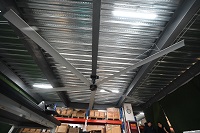
When ambient temperatures climb past 40°C and equipment bays feel like ovens, most motors start to sweat. Heavy-duty motors built for sustained high-heat operation don't rely on standard cooling tricks—they use reinforced insulation systems rated well above Class H, oversized bearing housings with high-temperature grease, and rotor designs that shed heat instead of trapping it. The result is a motor that holds torque and speed even when the air around it would cook lesser units.
The real test happens after hours of continuous load. Instead of derating output as the windings warm up, these motors maintain nameplate performance because their thermal margins aren't just theoretical. Manufacturers validate them through repeated thermal cycling, where the motor goes from cold soak to full load in a heat chamber, again and again. That kind of abuse separates motors that survive a hot afternoon from ones that keep a production line moving through an entire summer without a single thermal trip.
Field reports from foundries, glass plants, and desert pumping stations tell the same story: a heavy-duty high-temperature motor quietly does its job while standard models around it are being rewound or replaced. The upfront cost is higher, but when downtime from overheating costs thousands per hour, that premium disappears fast. It's not about buying a motor that tolerates heat—it's about buying one that doesn't care about it.
The Customization Options Most Manufacturers Won’t Offer
Most brands keep customization shallow: pick a color, choose a finish, maybe add a monogram. But the deeper changes—reshaping a grip to fit an old injury, building a left-handed version of a right-handed tool, or swapping in a material that was discontinued a decade ago—rarely make it past the design brief. The reason is simple math. Small-batch adjustments demand extra jigs, manual fitting, and a lot of back-and-forth that a high-volume line can't absorb.
Then there are the requests that don't even fit a standard order form. A customer might send a rough pencil sketch of a handle they dreamed up, or ask for slightly longer screws because their workspace has an unusual mounting depth. Some want the internal spring tension tuned softer or harder than the off-the-shelf spec. Others need a part matched to an older version of a product that was retired years ago. These aren't profitable for big factories, but for a workshop that builds one piece at a time, they're just another Tuesday.
What you end up with isn't a customized product so much as a small collaboration. Every odd request leaves a trace in the final piece—a slightly asymmetrical edge, a non-standard thread pitch, a finish that won't appear in any catalog. That's the difference between choosing from a menu and actually having a say in how something gets made.
How Ceiling Fan Placement Changes Cooling Efficiency
A ceiling fan’s cooling power depends heavily on how much air can move around the blades and into the room. Mounting the fan too close to the ceiling starves the intake side—air gets trapped between the blades and the ceiling, and the fan ends up spinning without pushing much air down. On a standard eight-foot ceiling, you want the blades roughly ten to twelve inches below the ceiling surface, with the blade tips at least seven feet above the floor. That clearance lets the fan pull air from above and throw it downward where people actually feel it.
Room geometry matters just as much as ceiling height. A fan centered in a square or slightly rectangular room distributes air evenly, but if you push it into a corner or place it near a tall armoire, the airflow hits obstacles and creates dead zones. Keep at least eighteen to twenty-four inches of clearance between the blade tips and any wall—less than that and the fan starts recirculating its own turbulent wake. In open-plan areas, one large fan may not be enough; offsetting a second smaller fan can cover the extra floor space better than a single oversized unit that just blasts the center.
For ceilings above nine feet, a flush-mounted fan is often a waste of energy. The blades spin near the ceiling, pushing air along the upper surface while the occupied zone below stays warm and stuffy. A downrod that lowers the fan so the blades sit eight to nine feet above the floor makes a dramatic difference—up to thirty percent more perceived airflow in some cases, according to manufacturer testing. Also check what is directly below the fan: a bed with a tall canopy, a high bookshelf, or a pendant light fixture can deflect the downward air column, so shifting the mounting point even a foot or two can restore cooling where you sit or sleep.
Lower Energy Bills Without Losing Airflow Power
Most high-efficiency fans sacrifice air movement to hit a lower wattage number. That trade-off doesn't have to exist. By pairing a carefully tuned blade geometry with a motor that holds its torque curve under load, you can push the same volume of air while drawing noticeably less current. The result is a room that feels breezy on a warm afternoon and a monthly utility statement that doesn't spike.
The savings come from where the energy usually disappears. Instead of letting heat build up in the motor housing or losing momentum to blade flutter, the design redirects that effort into steady, usable airflow. In practical terms, that means the fan can run longer at a comfortable setting without the meter racing. Over a full cooling season, the difference shows up as a smaller bill rather than a weaker draft.
It is a quiet kind of efficiency: no need to switch the unit off every few hours or settle for stagnant corners. The air keeps moving at the level you expect, while the electrical draw stays lean enough to notice. That balance between performance and consumption is what makes the lower energy figure feel like a bonus, not a compromise.
What to Ask Before Ordering Industrial Ceiling Fans
A fan that looks impressive on a spec sheet can quickly become a headache if you skip the questions that actually matter for your space. Before you place an order, dig into the details that affect daily operation and long-term reliability. How does the motor handle dust, moisture, or temperature swings? What are the real clearance requirements for blades and mounting height? These practical checks often reveal whether a unit will work with your building's layout or fight against it.
Installation and control options deserve more than a passing glance. Some industrial fans require specialized mounting brackets or reinforced ceilings that your facility may not have. Ask about variable speed drives, wall controls, or integration with existing automation systems. If the manufacturer can't give you a straight answer about wiring requirements or hang weight, that's a red flag. Also confirm whether the fan comes fully assembled or needs hours of on-site labor just to get the blades attached.
Finally, push beyond the basic warranty language. Find out how the company handles parts replacement, what happens if a motor fails mid-season, and who is responsible for shipping costs on returns. A ten-year warranty means little if you have to remove and crate a 200-pound fan yourself. The goal isn't to find the cheapest option—it's to find the one that won't create more work for your team down the road.
FAQ
Yes, they're built for exactly that. Our high-volume, low-speed designs push air across wide areas without creating disruptive drafts, so loading docks and racking aisles stay comfortable even on the hottest days.
We can adjust blade pitch, motor speed ranges, mounting extensions, and even add control systems that tie into existing building management. If your facility has unusual ceiling heights or obstructions, we'll adapt the fan package to fit rather than asking you to change the space.
Floor fans create strong, localized airflow but don't cover much square footage, and they take up floor space. Our ceiling-mounted units work from above to move a large volume of air gently, which cools people and helps reduce heat stratification without cluttering work zones or blocking forklift paths.
Absolutely. Many models use less than 1.5 kW at top speed while replacing the need for multiple smaller fans. Because they lower the perceived temperature by 3–5°C, you can often set the thermostat higher and cut air conditioning load, which shows up quickly on the power bill.
We offer sealed motors, stainless steel hardware, and anti-corrosion coatings for washdown areas, food processing, or coastal warehouses. Tell us about the environment, and we'll spec materials that won't rust or degrade after a couple of seasons.
Most standard installations finish in under a day per fan, including mounting and electrical hookup. We can schedule work around your off-peak hours or weekends, and our team handles everything from structural assessment to final balancing so your crew can keep working.
No, they're surprisingly quiet. The slow-rotating blades move air without the high-pitched whine of smaller axial fans. You'll notice the airflow more than the sound, which is important when workers need to hear alarms or communicate on the floor.
We back the fans with a five-year warranty on motors and a two-year warranty on blades and controls. Our support line is direct, and we keep common replacement parts in stock, so if something does go wrong, you're not waiting weeks for a fix.
Conclusion
Most industrial ceiling fans fall short because they treat your warehouse like a generic box. A customized manufacturer starts with the actual footprint, ceiling height, racking layout, and even the way your dock doors open, then engineers blade span, pitch, and mount length around those dimensions. That kind of fit changes how air moves through aisles and over workstations, not just around open space. Heavy-duty motors built for continuous peak heat mean the fan doesn't fade in August; it keeps pulling hot air up and pushing cooler air down without straining. And customization isn't limited to color or blade count—it can include variable speed profiles, reverse modes for winter destratification, corrosion-resistant finishes for washdown areas, and control integration with existing building systems. These are options many off-the-shelf suppliers simply won't touch.
Placement matters as much as the fan itself. Mounting height, lateral spacing, and distance from walls or ceiling obstructions can make a 30% difference in perceived cooling, so a good manufacturer will map airflow before quoting. The result is lower energy bills without sacrificing airflow power: fewer fans, placed correctly, often outperform a larger number of poorly positioned units. Before ordering, ask about motor type, warranty on gearboxes, expected CFM at your mounting height, noise levels at full speed, and whether the fan is truly engineered for your warehouse or just assembled from stock parts. If a supplier can't answer those clearly, you're not buying a customized solution—you're buying a ceiling ornament.
Contact Us
Contact Person: Michael Danielsson
Email: [email protected]
Tel/WhatsApp: +1 951 565 7769
Website: https://www.vindusfans.com