

ODM Portable Air Purifiers: A Complete Guide to Cleaner Air Anywhere
2026-09-04
Portable air purifiers have moved from niche gadgets to everyday essentials, but not all ODM options are built to keep up. This guide cuts through the noise—what makes a unit truly portable, which filter technologies actually work outside a lab, and where design meets real-world durability. If you're planning your next product line, LUFUTATECH brings the manufacturing know-how to turn these insights into cleaner air anywhere.
Clean Air That Follows You From Desk to Driver’s Seat
From the moment you settle into your morning routine, the air around you shifts. A compact unit on your desk hums almost inaudibly, drawing in dust, pollen, and the faint chemical traces left by office printers and synthetic fabrics. It does not shout for attention; its slim profile blends with notebooks and monitors, yet every few minutes the LED ring glows soft green, confirming it's actively scrubbing the space you breathe most.
When the workday ends, you slide the same device into the cup holder or clip it to the back-seat headrest. Within seconds of starting the engine, the cabin's stale, sun-warmed air gets pulled through the same dual-stage filter. The transition feels seamless because there is nothing to reconfigure, no app to pair, no mode to switch. It simply keeps doing what it did on your desk, only now the airflow pattern adapts to the curved, enclosed interior of your car.
The real difference shows up on long commutes and road trips. Your throat stays less scratchy, the dashboard collects less fine dust, and that faint smell of fast food or damp floor mats fades faster than you are used to. Clean air is no longer tied to one room or one vehicle. It moves with you, from desk to driver's seat, without asking you to think about it.
Why Shrinking a Home Purifier Isn’t as Simple as It Looks
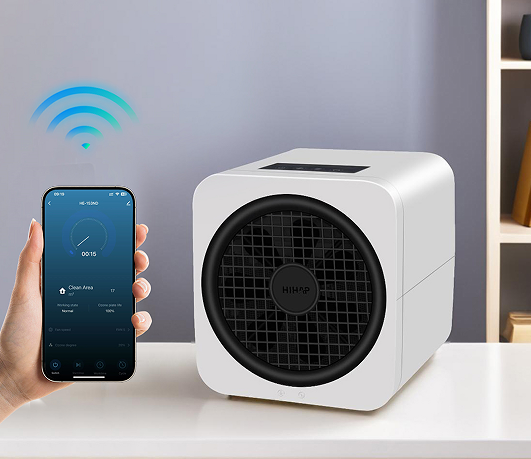
Most people assume a smaller purifier just needs a smaller fan and a thinner filter, but the physics of air cleaning don’t scale that way. A purifier’s real job is to move enough air through enough filter media to capture particles, and cutting the footprint cuts both at once. The filter surface area shrinks, which raises the pressure drop and forces the fan to work harder for the same airflow — or you lose airflow entirely. That’s why many compact models either run loud, burn through filters faster, or quietly push so little air that the room never actually gets clean.
Noise is another trap. In a full-size unit, a larger fan can spin at lower RPM and still move plenty of air. Once you shrink the housing, that same air volume has to squeeze through tighter channels and a smaller impeller, which means higher speeds and more turbulence. Sound levels climb quickly, and adding more acoustic padding eats the space you were trying to save. Manufacturers end up choosing between a tiny purifier that sounds like a hair dryer on low or one that’s quiet but only works in a closet-sized space.
Then there’s the filter itself. Real HEPA media needs depth and pleat spacing to hold dust without clogging in a week. Compress it too much and static pressure skyrockets; use a thinner alternative and you’re basically selling a screen, not a purifier. Even sensor placement gets trickier, since the intake and outlet are so close that the machine can end up re-reading its own cleaned air instead of the room’s actual pollution. Smaller is possible, but it always forces a compromise between airflow, noise, filter life, and the honesty of its air-quality readings.
The Filter Inside: What Actually Traps the Particles
Most people picture a filter as a simple sieve—big particles get stuck, small ones slip through. But the real work inside a high-efficiency filter is far messier and more interesting. Fibers are packed in a chaotic web, not a neat grid, and they catch particles through a mix of interception, impaction, and diffusion. A particle doesn't need to be larger than a gap; it just needs to wander close enough to a fiber that weak molecular forces grab hold and refuse to let go.
The fibers themselves are often electrostatically charged during manufacturing. That charge acts like an invisible magnet for fine dust, pollen, and even some bacteria, pulling them out of the airstream before they ever reach your lungs. Over time, as the filter loads up, the trapped particles form a cake layer that actually improves capture efficiency—right up until airflow drops too low and the filter needs replacing.
What's rarely mentioned is that the filter's inner structure is designed to create turbulence, not laminar flow. That turbulence increases the chance of collision between particles and fibers. So while the outside looks like a simple pleated panel, inside there's a carefully engineered maze where every bend and air vortex turns invisible particles into prisoners.
Matching a Unit to Your Daily Rhythms, Not Just Square Footage
Square footage is easy to measure and easy to compare, but it rarely captures how a home actually fits the shape of your day. A sun-filled breakfast corner that lands light exactly when you drink your first coffee matters more than a few extra meters in a hallway you only pass through. Start by mapping your weekday: when you wake, how you eat, where you work or study, when you need quiet, and how you wind down. Then test any unit against that rhythm instead of the floor plan's total area.
Pay attention to transitions and thresholds, not just room sizes. A unit might look generous on paper but force you to cross the bedroom every time you want to make tea, or place the only desk nook next to the building's trash chute. Think about how you move from one chunk of the day to the next: does the kitchen feel workable before you're fully awake? Is there a place to take a call without waking a sleeping partner? These are the details that determine whether a home supports your routines or quietly fights them.
Light, sound, and the direction of main rooms can outweigh square footage for daily satisfaction. East-facing windows might help you rise naturally but leave the living room dim by dinner; a compact layout with a separate alcove may give you more usable evening focus than a sprawling open plan. Before measuring closets, stand in the unit at the times you'll actually be home. If the space makes your ordinary Tuesday feel easier, it's likely a better match than a larger unit that only impresses on a tour.
Keeping a Portable Purifier Working Without Constant Attention
Many portable purifiers now include an auto mode that responds to real-time particle readings, so you don't have to keep adjusting the fan speed yourself. Once enabled, the machine will ramp up when it senses cooking smoke or dust and then settle back to a low hum when the air clears. For this to work reliably, place the unit at least a foot away from walls and large furniture—otherwise the sensor may read a dead-air pocket and either overwork or stay idle at the wrong times.
A few simple habits further reduce the need for constant fiddling. If your model has a timer or schedule function, set it to run during high-traffic hours and switch off automatically at night. Vacuum the outer mesh or pre-filter every couple of weeks; a quick pass with a brush attachment keeps the main filter from clogging early and triggering repetitive alerts. Also, only press the filter reset button after an actual replacement—doing it prematurely makes the unit misjudge the remaining filter life and beep for attention far more often than necessary.
When a Tiny Purifier Makes the Biggest Difference
There are moments when clean air matters more than square footage. A compact purifier tucked into a hotel room after a long flight, or running quietly beside a newborn’s crib, can do what a whole-house system cannot: address a single, intimate space with focused care. It’s not about covering every corner of a home—it’s about being exactly where you are.
Small purifiers earn their keep in personal spaces that larger units often ignore. Think of a desk in a shared office where recycled air lingers, a rental apartment with suspicious odors, or a studio kitchen after cooking. Because they’re easy to move, they follow daily routines rather than waiting for you to come to them. The real value is in the habit—placing it on a nightstand, letting it hum through a meeting, or setting it next to a litter box without dominating the room.
What makes the difference isn’t raw power but presence. A tiny purifier that fits on a windowsill or bookshelf gets used more often, which means it actually cleans the air you breathe most. When a big machine would feel like an appliance, a small one feels like a companion. That shift—from occasional tool to constant, unthinking helper—is where the biggest difference quietly happens.
FAQ
It stands for original design manufacturer. In practice, the company that builds the unit also handles the engineering and design work, so you’re often getting a product that can be customized or branded by different sellers without starting from scratch. For buyers, that usually translates to solid build quality and a wider range of features at a mid-range price.
They pull air through a small fan and force it past a filter, usually a HEPA or HEPA-style layer, which traps dust, pollen, pet dander, and some smoke particles. Many also add an activated carbon layer to grab odors. Because the space is small, the purifier can cycle the air multiple times per hour even with a modest fan speed.
A true HEPA filter is the one to prioritize, since it catches particles down to 0.3 microns. If you deal with smells or chemical fumes, look for a model that combines HEPA with an activated carbon layer. Avoid units that only use ionizers or washable foam, as they often leave the smallest particles floating around.
In a confined space, yes. A portable purifier with a genuine HEPA filter can reduce airborne allergens like pollen and pet dander noticeably within 20 to 30 minutes. For smoke, it helps with particulates, but no compact unit will remove all gases, so keep windows closed and pair it with the vehicle or room’s own ventilation when possible.
Most need a filter swap every three to six months, depending on how dusty the environment is. Wipe down the intake grille weekly, check the fan for debris, and don’t block the vents with bags or clothing. If the unit has a washable pre-filter, rinse and dry it completely before reinstalling.
Yes, the smaller the fan, the harder it has to spin to move the same amount of air, so some compact models get whiny at higher speeds. Look for a unit with a sleep or low mode around 25 to 35 decibels if you plan to use it overnight. USB-powered models are convenient but generally less powerful than 12V or wall-plug versions.
USB models work well for desks and hotel rooms where you already have a power bank or laptop nearby. Battery-powered units give you freedom in a car, tent, or during a power outage but need recharging. Plug-in purifiers deliver the strongest airflow and are best if you want consistent all-day performance in one spot.
Conclusion
A portable purifier earns its place when clean air stops being tied to one room. Moving between a desk, a car seat, or a hotel nightstand means the device has to cope with changing particle loads without demanding a reset each time. That explains why simply shrinking a home unit rarely works: airflow paths, seal tolerances, and filter surface area all shift at smaller scales, and a design that works in a living room can stall in a cup holder. The filter itself is the quiet workhorse. HEPA-grade media and activated carbon layers do the heavy lifting, but only if the housing guides air through them rather than around them. Good portables put the seal where it matters, so the trapped dust, pollen, and fumes stay trapped.
Choosing one is less about square footage and more about how your day actually unfolds. A commuter needs a unit that ramps up fast when traffic fumes spike, while someone working near a litter box or a dusty workshop needs longer, steadier filtration. Set-and-forget behavior matters too: filter replacement reminders, low-noise modes, and auto shutoff keep the gadget useful beyond the first week. In tiny spaces—a stuffy rental car, a cubicle with stale air, a nursery corner—small purifiers deliver the biggest noticeable shift, because even modest clean air delivery rates can turn a stagnant pocket into breathable space. The goal is not perfect lab-grade air everywhere, but fewer irritants in the places you actually occupy.
Contact Us
Contact Person: Paul Luo
Email: [email protected]
Tel/WhatsApp: 0086-19966314501
Website: https://www.lufutatech.com