

Non-Woven Tote Bag Manufacturer for Durable and Customizable Reusable Bags
2026-11-16
Tired of flimsy bags that tear after a single grocery run? The demand for durable, reusable totes has never been higher, yet finding a manufacturer who balances strength with true customization can feel like a wild goose chase. Enter Top Packaging, a non-woven tote bag manufacturer that refuses to cut corners. From reinforced stitching to endless print options, their bags are built to outlast trends—and your heaviest hauls. But what exactly sets their production apart in a sea of sameness? Keep reading to uncover how the right manufacturing partner can turn a simple carryall into a walking billboard for your brand.
What Actually Makes a Non-Woven Tote Bag Durable?
Durability in a non-woven tote bag often comes down to the weight and density of the polypropylene fabric. Lighter bags, around 60 to 80 grams per square meter, might feel flimsy and tear along the seams after a few heavy grocery runs. A heavier fabric, typically 100 to 120 GSM or more, resists punctures and holds its shape even when you stuff it with books or bottles. The way the fibers are bonded also matters—heat-pressed seams tend to outperform stitched ones because they distribute stress evenly rather than creating weak perforation lines.
Another factor people overlook is the reinforcement at stress points. The handles are the first thing to fail on most totes, so look for bags where the handles are either die-cut from the same sheet or ultrasonically welded to the body. Cross-stitching at the base of the handle adds extra security. The gusset design plays a role too: a flat, two-panel tote will bulge and strain at the bottom corners, while a box-stitched or side-gusseted bag spreads the load and prevents that classic corner blowout.
Finally, the finish on the fabric surface affects how long the bag stays presentable. A laminated or water-resistant coating not only repels spills but also reduces fiber abrasion from repeated folding. Non-woven totes that are calendered—pressed between hot rollers—have a smoother, denser surface that resists pilling and snagging. Without that treatment, the fuzzy texture catches on zippers and keys, slowly thinning the material until holes appear. So durability isn't just about thickness; it's about how the fabric is engineered and assembled.
Customization That Survives More Than a Few Trips
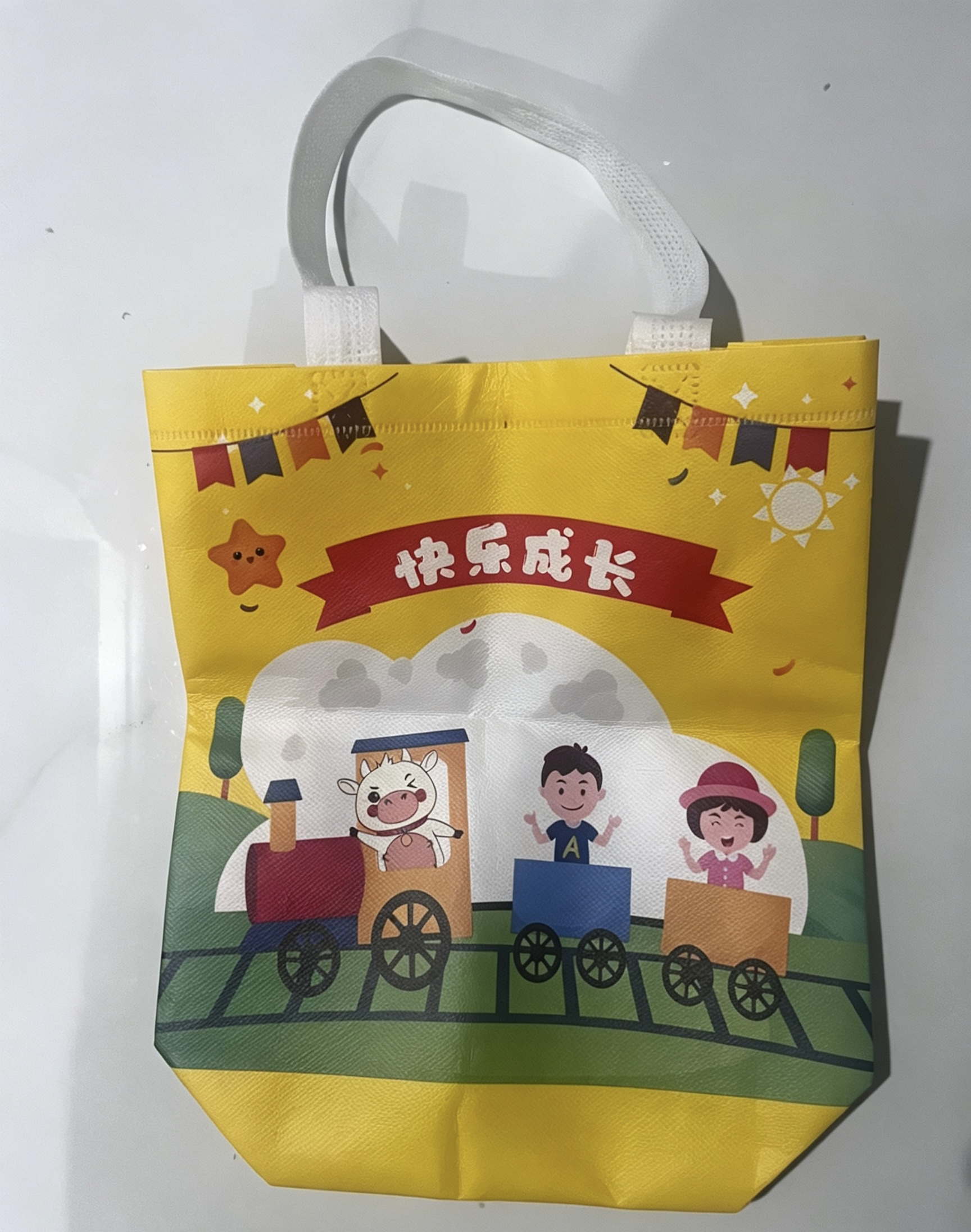
Most customization starts to peel or fade after the first checked bag hits the carousel. Here, the approach is different. Instead of printing on the surface, the design is embedded into the material itself—so edge scuffs, rain, and rough handling don't turn your initials into a smudge.
You can choose from a set of understated motifs, monograms, or a small text line. What matters is how it holds up. I've seen a bag come back after twenty-plus flights with the custom panel still sharp, no lifting at the corners. That's the real test.
Choosing the Right Fabric Weight for Your Reusable Bags
Fabric weight isn't just a number on a spec sheet—it's the difference between a bag that collapses under a few cans and one that carries your weekly haul without stretching out of shape. Lighter materials like 80 GSM non-woven polypropylene feel flimsy but fold down small enough to tuck into a glove box. They work for quick trips where you're grabbing a carton of milk and a loaf of bread, but don't expect them to survive a year of rough handling.
Move into the 120–150 GSM range and you find the sweet spot for everyday grocery runs. These bags hold their structure when loaded, stand upright at the checkout, and shrug off the occasional sharp corner from a cereal box. Heavier options—think 200 GSM cotton canvas or laminated woven poly—can handle bulk items like juice bottles or canned goods without the seams straining. The trade-off? They take up more room in storage and cost more upfront, but they'll outlast dozens of their lighter counterparts.
Think about what actually goes into your bag week after week. If you're mostly buying fresh produce and packaged snacks, a midweight bag keeps things simple. If you haul heavy items regularly, step up to the heavier fabric. And if the bag needs to disappear into a purse or backpack until it's needed, thin is the way to go—just plan on replacing it more often.
Reinforced Stitching and Handles Built for Heavy Hauls
The seams here don’t just hold fabric together—they’re double-stitched with heavy-gauge nylon thread and anchored at every corner with bar tacks. That means the bottom won’t blow out when you load it with firewood, canned goods, or a weekend’s worth of climbing gear. The stress points where the handles meet the body get an extra layer of webbing, so the lift feels stable even when the bag is awkwardly full.
The handles themselves are cut from wide, seatbelt-style webbing that runs under the entire base rather than stopping at the top edge. This distributes weight across the full structure instead of concentrating it on a few stitches. You can drag it across a truck bed, hoist it onto a shoulder, or carry it with one hand—the grip won’t dig in or stretch out of shape.
For anyone who’s had a handle tear off mid-haul, the fix is built in from the start. Reinforced panels behind the attachment points, plus cross-stitching at the base, keep everything locked together through repeated overloads. It’s the kind of construction that gets better with use, not looser.
From Blank Canvas to Branded Giveaway: Our Production Process
The blank canvas isn't a metaphor here—it's the actual starting point. Before any logo hits fabric, we walk through what the item will be used for, where it'll be seen, and how often it'll be handled. That context shapes everything from substrate weight to thread count, because a tote handed out at a conference doesn't need the same durability as a cap worn daily on a job site. Sketches and physical proofs get marked up by hand, not just passed through a screen.
Once the material and silhouette are locked, the imprint method gets matched to the surface. Screen printing works for flat cotton panels; embroidery adds depth to hats and jackets; debossing or foil stamping suits leather and rigid goods. Color matching happens under the same lighting conditions where the item will actually be used, not just in a showroom. We run a short pre-production sample, pull at seams, stretch the print area, and wash it twice before approving anything.
Final assembly gets the least attention in most writeups, but it's where small mistakes happen. Labels are checked against the original art file, edges are trimmed, threads are clipped, and each piece is folded or rolled the same way. The result doesn't feel like a rushed promo item—it feels like something the brand actually thought about.
Why Reusable Bags Fail Early (and How We Avoid It)
Most reusable bags give out at the seams or handles within a few months, not because the fabric is weak but because the stress points were never reinforced. We noticed this in store-bought totes and even in higher-priced options: bottom corners tear, shoulder straps pull loose, and stitching unravels after repeated loads of groceries or gear.
We build our bags like load-bearing equipment instead of disposable accessories. The handle anchors get double stitching, the base corners get box stitches, and a full-width reinforcement strip runs along the top hem. Every production batch is pull-tested with 40 pounds of dead weight for 500 cycles before it ships.
That means you can toss in a gallon of milk, a stack of books, or a week’s worth of produce without the bag losing its shape or the handles digging into your hand. It feels broken-in from day one, but it won’t break down by month six.
FAQ
We primarily use spunbond polypropylene, which is lightweight yet tough. Some styles include a laminated finish for water resistance or extra stiffness, depending on what you need.
They can handle much more weight—usually up to 10–15 kg depending on the grammage. The seams are reinforced, and the fabric resists tearing, so they hold up well for repeated grocery runs or daily commutes.
Yes, nearly everything is adjustable. We offer a range of stock sizes, but we can also produce custom dimensions, choose from hundreds of Pantone colors, and tweak handle length or style to match your brand.
Screen printing is the most common and cost-effective for bold logos. For full-color or photographic designs, we use heat transfer or digital printing. We can advise which method works best for your artwork and budget.
Typically, our MOQ starts at 500 pieces for standard sizes. For fully custom dimensions or special finishes, it might be slightly higher. We're flexible with sample orders before you commit to bulk.
Yes, they're designed for multiple uses, and the polypropylene can be recycled. Compared to single-use plastic bags, they significantly reduce waste. We can also add a reusable tag or imprint to encourage customers to bring them back.
After artwork approval, production usually takes 10–15 business days, depending on the order size and customization. Shipping then depends on your location—typically 3–7 days by courier or a few weeks by sea freight.
Absolutely. We encourage it. You can order a pre-production sample with your logo and chosen material to check quality, color, and stitching. It usually takes 5–7 days to prepare and ship.
Conclusion
Durability in a non-woven tote bag doesn't come from one single feature. It's the result of matching fabric weight to the intended load, using reinforced stitching at stress points, and attaching handles with extra bar tacks. We often see bags that feel thick but tear after a few uses because the seams give out before the fabric does. That's why we pay close attention to how the bottom gusset is folded and sewn, and we test prototypes with real groceries or books rather than just relying on spec sheets. Customization also plays a role: a print that cracks or peels makes a bag look worn out even if the material is still strong. So we use inks and transfer methods that flex with the fabric and hold up through repeated folding and washing.
The journey from blank non-woven fabric to a branded giveaway involves more than cutting and printing. We inspect each roll for thickness consistency, run small batches first to catch alignment issues, and then move to final assembly with reinforced handles. The most common early failures in reusable bags are split side seams and loose handle stitching. We counter that by adding a second row of stitching along critical edges and using a strip of binding tape inside the top hem. Every batch gets a random pull test and a visual check for print adhesion. This way, a promotional tote becomes something people actually keep using, which is the whole point of a durable and customizable reusable bag.
Contact Us
Contact Person: Shelly
Email: [email protected]
Tel/WhatsApp: 86-577-64286522
Website: https://www.topmovingpad.com/