

Inside a Digital Oscilloscope Factory: Where Precision Meets Production
2026-05-29
Step into the world where raw circuit boards transform into precision instruments. At the heart of modern electronics, digital oscilloscopes are born from a blend of meticulous craftsmanship and automated wonder. In this behind-the-scenes journey, we explore a factory where every signal is scrutinized, every component placed with intent. Discover how TPS pushes the boundaries of production, turning complex designs into reliable tools that engineers trust. Get ready to see technology in the making—where innovation meets the assembly line.
The Art of Signal Integrity: Crafting the Core
Signal integrity is less a rigid discipline and more a practiced craft, where every trace, via, and reference plane plays a deliberate role in the final performance. It demands a careful balance between physics and intuition—knowing when to trust a field solver and when to rely on the subtle tells of a waveform that doesn't quite behave. The most elegant designs aren't those that simply meet the eye diagram mask, but those where the signal's journey feels almost inevitable, as if the board itself guided the energy home.
At the heart of this craft lies the art of impedance control, where a few microns of dielectric thickness or a subtle variation in weave pattern can define success or failure. Beyond calculations, there's the quiet satisfaction of stitching return paths so seamlessly that the current never questions its route. Stackup design becomes a composition of layers, balancing cost, manufacturability, and the need for tight coupling, while differential pairs dance in lockstep, their skew and spacing tuned with a watchmaker's precision.
Tools matter, but instinct honed by prototyping and failure elevates the work. The core is shaped through iterative refinement, probing test boards at midnight, and learning to hear what the signal is whispering about resonance, reflection, or buried crosstalk. In that moment, crafting the core isn't a task—it's the engineer's quiet dialogue with the board, where every adjustment is a stroke on a canvas that most will never see but many will depend on.
Automated Precision: Where Robots Meet Oscilloscopes
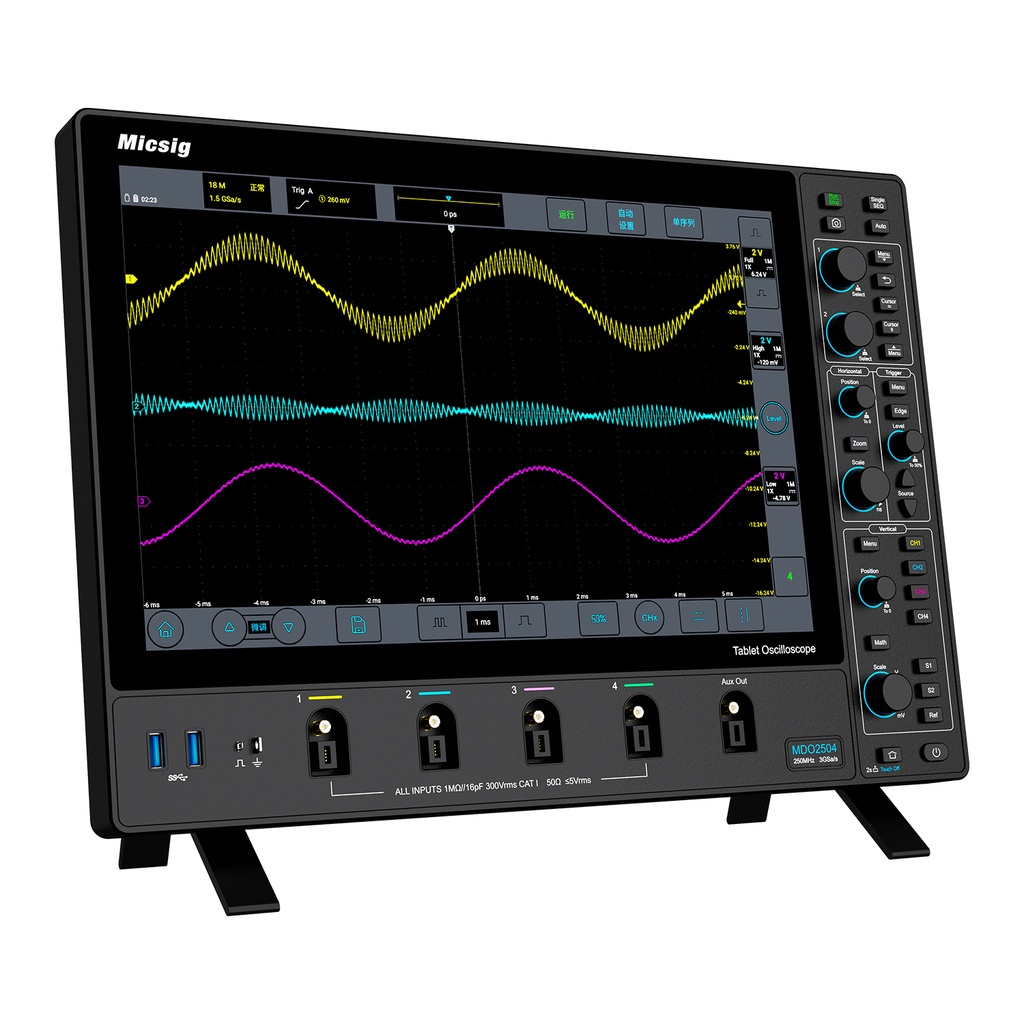
In the dim glow of a testing lab, a robotic arm glides smoothly across a bench, its gripper delicately positioning a probe onto a circuit board. Nearby, an oscilloscope springs to life, rendering crisp waveforms that reveal the secrets of high-speed signals. This isn't a scene from a futuristic factory—it's the emerging reality of automated precision, where robotics and oscilloscopes converge to reshape electronic test and measurement. By marrying mechanical dexterity with electrical insight, engineers are pushing beyond manual limits, capturing data with repeatability and speed that human hands simply cannot match.
The dance between robot and scope is choreographed by software that synchronizes every movement with signal acquisition. A robot may execute a sequence of probing points across a dense PCB, while the oscilloscope triggers on specific events, automatically adjusting timebase and voltage scales. This tight integration eliminates the variability of operator technique and unlocks 24/7 testing cycles. In high-volume production environments, such systems catch intermittent faults that would otherwise slip through batch sampling, turning each device into a fully characterized specimen rather than a statistically acceptable risk.
The fusion of these tools also sparks new possibilities in realms like RF alignment and power integrity analysis. A robot can hold a near-field probe with micron-level consistency, mapping electromagnetic emissions across a shield enclosure while the oscilloscope stacks hundreds of sweeps into a 3D heatmap. What once demanded hours of delicate manual scanning now unfolds in minutes with greater fidelity. As collaborative robots become more accessible and scopes more intelligent, the line between the technician and the test stand blurs—giving rise to labs that not only measure but also learn, adapt, and refine their own processes over time.
Calibration Sanctum: Ensuring Every Trace Tells the Truth
In the realm of precision measurement, even the slightest deviation can cascade into significant errors downstream. The calibration sanctum is not merely a room filled with instruments—it’s a controlled haven where environmental variables like temperature, humidity, and vibration are meticulously tamed. Here, every gauge, sensor, and reference standard undergoes a ritual of verification against known benchmarks, ensuring that each trace aligns with an unbroken chain of accuracy stretching back to national or international standards.
What sets this space apart is its unwavering commitment to traceability without compromise. Technicians follow strict protocols, often double-checking measurements using different methods to rule out systemic biases. The data generated isn’t just numbers on a screen; each point carries a story of uncertainty and confidence, documented in detailed certificates. This practice transforms raw readings into trustworthy evidence, making the sanctum a guardian of truth in fields ranging from aerospace to medical diagnostics.
Beyond the hardware, the calibration sanctum embodies a philosophy of continuous vigilance. Regular interlaboratory comparisons and proficiency tests ensure that the truth spoken by one instrument harmonizes with those in other facilities. By refusing to cut corners, this sanctuary preserves the integrity of measurements that underpin safety, innovation, and scientific discovery, quietly ensuring that every trace indeed tells an honest story.
From Schematic to Silicone: The Prototyping Journey
Turning an idea into a physical device often starts with a rough schematic sketched on paper or laid out in EDA software. That initial diagram captures the logic—components, connections, power rails—but it's still just a promise. The real test comes when you translate those lines and symbols into copper traces, solder joints, and finally a working board. Even a perfectly routed PCB can feel worlds apart from a product that fits comfortably in someone's hand. That leap from rigid FR4 to soft, durable silicone is where prototyping gets both challenging and deeply rewarding.
Silicone isn't just a casing material; it can become the structure itself. We've experimented with embedding circuits directly into flexible substrates, curing silicone around LEDs and sensors to create wearables that move with the body. Early prototypes often involve 3D-printed molds and careful material selection—some silicones cure at room temperature, others need heat, and each affects the embedded electronics differently. The journey is littered with failed castings, bubbles trapped in unexpected places, and cables that snapped during demolding. But those failures teach more than any simulation ever could.
What bridges the schematic and the silicone is an iterative mindset. You scout connectors that won't corrode when encapsulated, rethink board shapes to survive repeated bending, and sometimes rewrite firmware to handle the slight changes in capacitance or signal integrity caused by the new environment. By the time you hold a fully functional, soft prototype, you've not only validated the circuit but also discovered how the design needs to evolve for real-world use. That moment—when the gadget stops being a collection of components and starts feeling like an actual product—is what drives every prototyping sprint.
The Human Touch: Skilled Hands in a High-Tech World
In an era where algorithms drive decisions and automation reshapes industries, the true differentiator isn't raw processing power—it's the nuanced judgment that comes from years of hands-on experience. While machines excel at pattern recognition, they falter when context shifts unexpectedly. A master carpenter feels the grain of the wood, adjusting their technique in ways no sensor can replicate. A seasoned nurse notices the subtle change in a patient's breathing long before monitors sound an alert. These moments don't arise from programmed logic but from a deep, embodied understanding that technology can augment but never replace.
Consider the way a potter's thumb coaxes clay into symmetry or how a watchmaker's steady fingers navigate microscopic gears. Each motion carries a history of trial and error, a tactile memory that refines itself over decades. This is where human skill shines: in the friction between intention and material, where unexpected outcomes spark innovation. When we try to digitize these crafts, we often strip away the very serendipity that leads to breakthroughs. The tool becomes the master, and the subtle feedback loops of creative work dissolve into rigid processes.
The most resilient systems are those that weave together precision machinery with the irreplaceable spark of human ingenuity. It's not about rejecting technology but about preserving the space for intuition and improvisation. Factories that empower workers to tweak robotic workflows see fewer defects than fully automated lines. Surgeons using robotic assistants still rely on their own perception to make critical calls. In the end, the hands that built the first tools still hold the key to unlocking the potential of our most advanced ones—not through brute force, but through the wisdom that only comes from doing, feeling, and adapting in real time.
Resilience by Design: Testing Beyond Limits
Building systems that hold together when everything else falls apart isn’t about luck — it’s a deliberate choice made long before the first failure. We push our designs into deliberately harsh conditions, far past any reasonable operational envelope, because only then do the hidden assumptions surface. A server rack baked in 60°C heat, a UI bombarded with gibberish inputs, a network starved of bandwidth until it chokes — these aren’t edge cases we hope never occur; they’re the rooms where our designs learn to stand.
This obsession with breaking things early changes how we think about architecture. Instead of patching symptoms after each incident, we bake resilience into the skeleton from day one. Circuit breakers that don’t just trip but gracefully degrade entire subsystems, retry budgets that learn from past patterns rather than blindly hammering a dying endpoint, and state management that survives process death without corrupting user data — all these emerge from a discipline of testing not to verify, but to wound and watch the healing.
The difference between something that merely works and something that survives shows up when you stop treating test failures as bugs and start treating them as design critiques. Every crash under synthetic load becomes a story about coupling, every silent data loss reveals a missing safeguard. By the time our systems reach production, they’ve already faced the worst we could imagine — and proved they can bend without breaking, because we refused to let them hide behind the assumption that real users would stay within the lines.
FAQ
Workstations feature ionized air blowers and grounded, dissipative flooring. Board handling is kept to a minimum, and any contact requires static-safe gloves and wrist straps tested at the start of each shift.
After a day-long burn‑in cycle, an automated test system measures rise time and frequency response using calibrated pulse generators and vector network analyzers, flagging anything that deviates beyond a narrow guard band.
Mounting the analog front‑end chipset. These custom ASICs sit on a high‑density interconnect board where even microscopic soldering flaws cause reflections that distort GHz signals, so every joint gets X‑ray inspection.
Absolutely. While pick‑and‑place machines populate SMD components flawlessly, final display alignment, shield‑can fitting, and the subtle tightening of RF connectors still rely on experienced technicians who can feel when something isn’t quite right.
They’re diverted to a failure analysis bay. Engineers use active probes and spectrum analyzers to isolate the root cause, then either rework the board or update the production process to prevent recurrence—no unit is scrapped without a forensic report.
All measurement gear in the factory is itself calibrated weekly against NIST‑traceable references, and we run a golden‑unit sanity check at the start of every production shift to catch even minor drifts in the test infrastructure.
The quiet. Despite rows of automated stations and test racks, sound levels are surprisingly low—just the whisper of climate control and the soft rhythmic click of robots placing components, which people expect to be a cacophony.
Conclusion
Step inside a modern digital oscilloscope factory and you’ll find a meticulous blend of art and science where signal integrity is paramount. Crafting the core of these precision instruments begins with carefully engineered analog front ends and ultra-low noise circuits, often hand-tuned by skilled technicians who understand that every microvolt matters. In the prototyping lab, engineers transform schematics into silicon, iterating through board spins to perfect the delicate balance between bandwidth, sample rate, and noise floor. This is where the human touch converges with high-tech automation, as robotic assembly lines handle micro-soldering and component placement with micron-level accuracy, yet seasoned hands still perform final adjustments that machines cannot replicate.
Beyond assembly, the calibration sanctum serves as the heart of truth: each channel is tested across temperature extremes and signal amplitudes using automated rigs that simulate years of real-world stress in minutes. Rigorous resilience testing pushes units beyond rated limits—voltage spikes, thermal shocks, and vibration profiles ensure the oscilloscope stays accurate even in harsh industrial environments. Throughout the factory, statistical process control and real-time data analytics track every trace, but it’s the collective dedication of engineers, calibrators, and technicians that guarantees each instrument leaving the floor will faithfully capture the signals that matter most.
Contact Us
Contact Person: Lily
Email: [email protected]
Tel/WhatsApp: +49 (0) 2161 49526-0
Website: https://tps-elektronik.com/en/