

FRPSkin Lite OEM Refrigerated Truck Body in China: Lightweight and Efficient
2026-08-13
Reefer bodies are often overbuilt, quietly eroding fuel economy and payload. FRPSkin Lite changes that equation. As an OEM refrigerated truck body manufactured in China by Whole Chain Tech, it pairs lightweight materials with efficient thermal performance. The result? A compelling reason for fleet operators to reconsider their next spec.
The Weight-Saving Design Behind FRPSkin Lite Panels
FRPSkin Lite panels cut mass at the material level. A low-density polypropylene honeycomb or foam core replaces the resin-heavy middle layer found in conventional fiberglass sheets. The outer skins stay thin—often under 1.5 mm—because the core handles shear loads, while the faces carry bending stress. This separation of duties lets the panel use roughly half the fiberglass by volume without giving up puncture resistance or flatness.
The weight drop isn't just about swapping materials. The panel's edge geometry and internal rib spacing are tuned so that stress flows through the skin-to-core bond lines rather than accumulating at corners. As a result, the overall thickness can be reduced from a typical 3–4 mm solid laminate to a 10–12 mm sandwich that weighs less but spans further between supports. Installers notice fewer framing members needed, and transport costs fall because more panels fit on a single pallet.
Why Lightweight Doesn't Mean Fragile for These Reefer Bodies
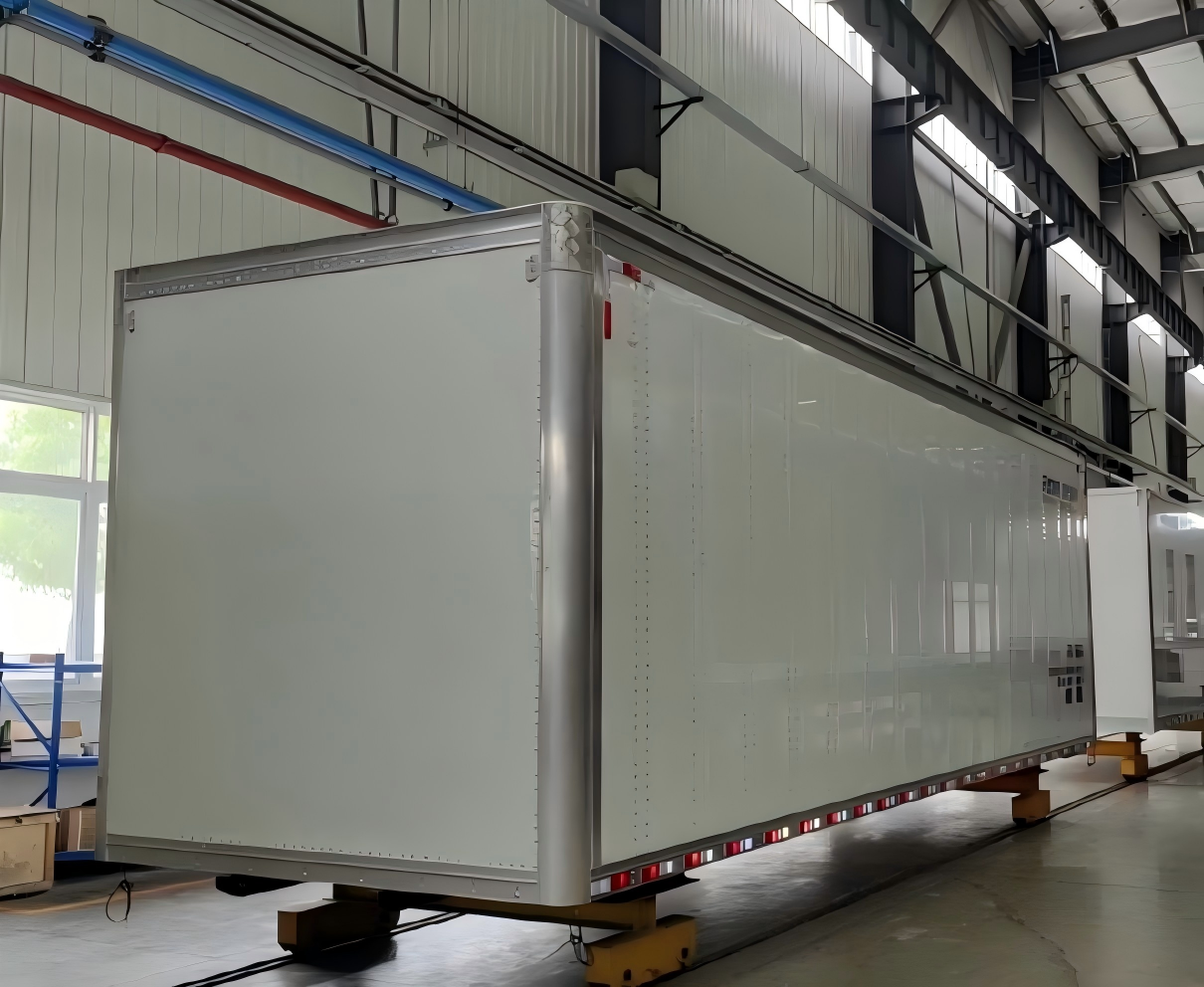
The move to lighter reefer bodies doesn't come from shaving material off critical areas. Much of the weight reduction comes from replacing heavy plywood and steel liners with thermoplastic honeycomb panels or closed-cell foam cores sandwiched between glass-reinforced skins. These composites deliver higher specific stiffness than traditional materials, meaning the walls and roof resist bending and impact better per kilogram. At the same time, high-stress zones like corner posts, door frames, and floor edges keep their strength through extruded aluminum or high-strength steel inserts, so the structure doesn't rely on bulk to survive daily abuse.
Road and loading conditions put these bodies through constant twisting, vibration, and occasional forklift hits. Engineers use finite element analysis to identify where the original heavy design had excess material and where it was actually needed. Load paths get redirected to reinforced rails and bonded joints that combine structural adhesives with mechanical fasteners. This creates a continuous, tough shell that doesn't crack at seams the way older welded or riveted-only assemblies sometimes did. The result is a lighter body that often outlasts heavier predecessors in real fleet operations because it flexes more predictably and sheds impact energy rather than concentrating it.
Field experience backs this up. Fleets report that well-designed lightweight reefer bodies hold up to multi-shift grocery delivery or long-haul frozen transport without warping or losing thermal integrity. Less weight also reduces stress on hinges, suspension, and refrigeration unit mounts, which lowers maintenance downtime. So the "lightweight" label refers to smart material choices and targeted reinforcement, not a compromise in durability.
How OEM Builds in China Keep Cold Air In and Fuel Costs Down
In Chinese OEM facilities, thermal isolation starts long before final assembly. Door seals are tested under sub-zero chamber conditions, measuring compression recovery after tens of thousands of open-close cycles. This isn't just about fit; it means the cab retains heat on a cold highway without the HVAC system constantly cycling on and off.
Powertrain calibration is another quiet advantage. Engineers map cold-start fuel delivery to shorten idle time, while insulated fuel lines and block heaters prevent diesel gelling in northern provinces. The payoff shows up in fleet logs as fewer liters burned during warm-up, not just in lab tests.
Aerodynamic details are stamped into the metal early. Tighter bumper gaps and factory-installed underbody shields reduce turbulent airflow that drags cold air into the engine bay. With steadier operating temperatures, the engine stays in its efficient band longer, cutting consumption without extra driver effort.
The Payload Math That Changes with a Lighter Truck Body
When a fleet manager starts swapping steel bodies for aluminum or composite ones, the first number that jumps out is the curb weight. Drop 800 pounds from the bed, and suddenly the same chassis can legally carry 800 more pounds of cargo before hitting its gross vehicle weight rating. That part is straightforward arithmetic. But the real payload math rarely stops there.
Axle ratings and tire load limits often become the hidden gatekeepers. A lighter body shifts the weight distribution forward or backward depending on where the savings occur, and that can push the front axle closer to its maximum while the rear axle suddenly has more headroom. In practice, a truck that looks like it gained a full half-ton of payload on paper might only be able to use 600 of those pounds once you account for the new balance point.
There's also the matter of how the lighter body behaves under load. Less mass up high lowers the center of gravity, which can reduce body roll and make a fully loaded truck feel more stable than its heavier predecessor. That doesn't show up in a simple GVWR minus curb weight equation, but drivers notice it on off-camber corners and during emergency lane changes. The numbers on the spec sheet change first; the numbers that matter on the road follow a slightly different curve.
What Daily Cold Chain Routes Demand — and How FRPSkin Lite Delivers
Cold chain logistics grinds through the same unforgiving loop every morning: a van idling outside a loading dock, pallets sweating under plastic wrap, and a driver checking the clock before the first drop. The demand isn't romantic—it's constant temperature control across short hops that rarely exceed six hours, protection against door openings that leak cold air, and packaging that survives being slid, stacked, and occasionally dropped by rushed hands. FRPSkin Lite answers with a shell that flexes instead of cracking, holding its thermal line even when the rear doors swing open for the ninth time.
Most standard liners fail quietly: a corner tears, condensation pools, or the reflective layer delaminates after a week of daily abuse. FRPSkin Lite takes a different route, using a reinforced skin that resists puncture while keeping the interior surface wipeable and non-absorbent. Drivers don't need to nurse it; they load fast, close the door, and trust the next stop won't involve a rejected pallet because the fish fillets climbed two degrees.
For route managers, the real cost isn't the liner itself—it's the variance. One warm zone near the door can spoil a whole order, and replacing cheap insulation every month adds up faster than fuel. FRPSkin Lite flattens that variance by maintaining an unbroken barrier edge-to-edge, with taped seams that stay put through washdowns and forklift grazes. The result reads less like a marketing claim and more like a shift in how a daily route actually runs: fewer checklists, fewer temp logs marked in red, fewer calls from a customer holding a thermometer.
Inside the Thermal Break That Sets FRPSkin Lite Apart
Most thermal breaks rely on a single polymer strip pressed between metal profiles, but FRPSkin Lite rethinks that junction entirely. The break here is not an afterthought slotted into an extrusion; it is a continuous, low-conductivity core that separates the interior and exterior skins across the full panel depth. That uninterrupted layer eliminates the short, direct metal-to-metal paths that typically leak heat at fasteners, joints, and edge returns. As a result, the surface temperature stays far more uniform, and condensation risk drops even in high-humidity interiors or sharply cold exterior conditions.
The geometry does as much work as the material. Instead of a flat divider, the thermal break follows a stepped profile that lengthens the conductive path without adding bulk. Small rebound flanges key the FRP skins into place, so the assembly remains stiff under wind load while the thermal barrier stays uncompressed. Because the core is cast around the panel edges rather than mechanically clipped in, there are no secondary screws or brackets to act as thermal short circuits. That one change removes a failure point common to many rain-screen and cladding systems.
On site, the difference shows up in both energy modeling and feel. Panels no longer develop the tell-tale cold bands near their perimeter, and interior finishes can be installed closer to the facade without worrying about dew point migration. For designers, that means slimmer wall buildups and fewer interruptions from thermal isolators. For building owners, it translates into steadier indoor temperatures and lower peak heating demand during the first cold snap of the year.
FAQ
The body uses FRP skin panels with a foam core, cutting overall weight while keeping structural strength intact.
Its seamless sandwich construction minimizes thermal bridges, so temperatures stay stable with less energy draw from the refrigeration unit.
Yes, it is built to order, so dimensions, door placements, and internal fittings can be adjusted to match specific chassis and operational needs.
FRP resists corrosion and dents, provides better insulation, and reduces condensation compared to standard metal skins.
It works well for long-haul runs because the lighter body improves fuel economy and the robust insulation holds temperature over extended trips.
Fleet operators receive factory-direct bodies that integrate cleanly with their trucks, simplifying warranty support and spare parts sourcing.
It suits temperature-sensitive goods like fresh produce, dairy, frozen foods, and pharmaceuticals that need strict cold chain control.
The smooth FRP surface is easy to clean, does not corrode, and requires less frequent repainting or panel replacement.
Conclusion
FRPSkin Lite panels achieve their weight reduction through a composite structure that replaces much of the metal framework with high-density foam cores and fiberglass skins, cutting hundreds of kilograms compared to conventional steel or aluminum reefer bodies. This does not compromise durability: the panel bonding process distributes stress evenly, and reinforced corners resist the twisting and impacts common on uneven Chinese highways. OEM builders in China integrate these panels into box bodies with precision sealing, which keeps cold air from leaking while the lighter chassis reduces engine strain and lowers diesel consumption on long hauls across provincial lines.
The weight saved translates directly into a significantly higher legal payload capacity, allowing operators to load more cargo per trip without exceeding axle limits or paying overweight penalties. Daily cold chain routes often involve frequent door openings, tight urban deliveries, and extended idling; the thermal break embedded in FRPSkin Lite panels slows heat transfer through the frame, helping the refrigeration unit maintain stable temperatures with fewer compressor cycles. This combination of structural efficiency and insulation performance gives fleets a tangible edge in both operating cost and delivery reliability in China's demanding cold chain market where tight margins make every kilogram and degree count.
Contact Us
Contact Person: Ethan
Email: [email protected]
Tel/WhatsApp: +86 13963964935
Website: https://www.wholechaintech.com/