

China Y Strainer Selection Tips for Reliable Pipeline Performance
2026-11-17
Most pipeline failures don't start with a dramatic rupture. They begin with a Y strainer that was almost right. A mesh too coarse, a pressure drop overlooked, a material mismatch — each one quietly eats away at performance until the line shuts down. Buying from China gives you plenty of choices, but more options don't automatically mean more reliability. The difference comes down to how you select. In this guide, we move past generic 'buy stainless steel' advice and focus on the details that keep flow steady and maintenance predictable. For teams that prefer a proven source over trial and error, UPTAI supplies Y strainers built to match real operating conditions. Here are the selection points that matter before installation.
Dirt Load First, Pipe Diameter Second
Most drainage failures don't start with a narrow pipe. They start when the actual dirt load is guessed rather than measured. Fine sediment, grit, and organic sludge move differently under low flow, and these characteristics shape how much solid material a line has to carry before fluid capacity ever becomes a limiting factor.
Working out the expected dirt load first changes the sizing conversation. Instead of picking a diameter from a standard table and then hoping the solids pass, you check the particle size, settle rate, and how often the line will run below self-cleaning velocity. Only after those values are clear does pipe diameter turn into a useful decision rather than a default assumption.
That order also helps avoid overbuilding. A larger pipe can make things worse if it reduces flow speed and lets debris drop out of suspension. When dirt load leads the design, the diameter supports the velocity and carry capacity you actually need, which tends to produce a cleaner line with fewer callbacks.
Screen Openings That Match the Particles You Actually See
A sieve chart will tell you one story, but the material on your bench often tells another. When particles are elongated, flaky, or slightly sticky, they do not pass through an opening based only on their nominal diameter. They tumble, bridge, and sometimes slide through at an angle. That is why the most useful starting point is to spread a sample under a microscope or macro lens and compare what you see against the actual slot width. If the bulk of the particles are needle-like, a square opening sized to the median particle width may still trap a surprising amount of material, while a slotted opening with the same width lets them drop through cleanly.
It also helps to run short, hands-on trials before committing to a full setup. Take a handful of the real feed, shake it over a candidate panel by hand, and watch whether near-size particles wedge into the openings or bounce loose. You will often notice that a screen built for a certain cut size performs better one step coarser or with a different wire profile, simply because the opening shape matches how the particles actually present themselves. Let those observations guide the final choice more than the particle size distribution alone.
Why Pressure Drop Changes After a Few Weeks in Service
In the first hours of service, a new element usually shows a fairly flat pressure drop. The media is clean, the pores are open, and the differential mostly reflects fluid viscosity and flow rate. After a few weeks, that baseline rarely holds. The most common reason is progressive loading: fine particles that passed through early on begin to embed in the depth of the media, reducing pore size and raising resistance. What often surprises maintenance teams is that the change is not linear. Once a thin contaminant cake starts forming on the upstream surface, even small additional dirt can produce a noticeable jump because the cake itself becomes the dominant flow restriction.
There are also mechanical changes taking place inside the element. Sustained differential pressure can cause fiber relaxation or slight media compaction, especially in depth-style cartridges. As the structure settles, local flow paths shift: some areas tighten while others open slightly, which can temporarily slow the rate of rise or create a step change. In hydraulic and lubrication systems, the fluid itself ages over the same period. Oxidation, additive breakdown, or water contamination alters viscosity and can make the fluid more drag-heavy through the media, adding to the pressure drop even when the dirt load has not changed much.
A third influence is system operation. A filter that sees steady conditions during commissioning may later experience warmer oil, higher intermittent flow, or a slight valve adjustment. These variables change the baseline differential and make it look as if the element has loaded faster than it actually has. For this reason, a pressure drop reading taken after a few weeks should be compared against the current operating conditions, not against the clean-room value recorded at startup.
Material Choices for Liquids That Are Not Plain Water
Plain water forgives a lot of material sins. Swap in brine, citric acid, fuel, or even high-purity water and that forgiveness disappears. The first shift is usually from generic stainless steel or basic plastics to grades chosen around the specific chemistry. Chloride-bearing liquids, for example, will pit 304 stainless while 316 or a duplex alloy holds up far longer. Polypropylene might handle many acids at room temperature but turns brittle with some solvents, so a fluoropolymer like PVDF becomes the safer pick when the chemical mix is not fully known.
Elastomers and seals tend to fail before pipes or housings do. A pump that moves water with an EPDM diaphragm can swell badly in oils or fuels; a switch to Viton or PTFE-backed seals often prevents downtime. The same logic applies to gaskets, O-rings, and tubing. Matching the wetted material to the liquid's temperature matters too, because warm aggressive fluids attack materials much faster than cold ones, and some plastics lose pressure ratings well below their listed maximums.
For food and beverage liquids that are not plain water, the material choice has to balance chemical resistance with cleanability and taste neutrality. Sugars, weak acids, and cleaning agents create cycling exposure, so materials like 316L stainless or certified thermoplastics are common. For ultrapure water or sensitive biological fluids, even trace metal ions or plasticizers leaching from the wrong polymer can ruin a batch, which pushes selection toward PVDF, PFA, or electropolished stainless rather than standard off-the-shelf parts.
Positioning the Strainer So Maintenance Does Not Become a Shutdown
Place the strainer so the blowdown port and the basket can be reached without shutting off upstream equipment or squeezing past a pump skid. A few extra feet of straight run before the inlet gives the basket room to come out cleanly, and lets a drain pan sit under the housing instead of hoping drips land somewhere harmless.
If the line cannot be taken offline, build the location around a bypass or a duplex housing from the start. Mount the isolation valves where the handle throw is clear, and orient the lid so it opens away from electrical enclosures and steam traces. Maintenance then becomes a switch-and-clean routine rather than a plant-wide stop.
Height matters just as much as clearance. Keep the cover at chest level or lower so the basket can be lifted without a chain fall, and point the drain toward a sloped trough or container connection. When the position supports the full cleaning sequence, crews are more likely to service the strainer on schedule instead of waiting for pressure drop to force it.
Custom Screen and Drain Requests Worth Making Before Ordering
Most suppliers will happily tweak standard configurations if you ask before the order is locked in, and skipping this step often means living with small annoyances for years. A slightly coarser mesh on the screen might let more light through while still keeping out the debris you actually deal with, and adjusting the drain location from center to a rear corner can make hose routing far cleaner. These are not premium add-ons—they are just conversations worth having.
Think about how the unit sits in your space, not how it looks in a catalog photo. If you are installing over a sloped floor or against a wall with existing plumbing, requesting a side outlet or a deeper catch basin can save you from awkward elbows and reducers later. Even the screen frame material matters: a powder-coated finish might match your trim better than the default brushed metal, and that small shift changes the whole look without costing much.
Write down your daily use pattern before calling. Do you rinse tools, wash produce, or strain paint water? Each habit points to a different screen aperture and drain grate style. Suppliers hear vague requests all the time, but a specific note like “I need the drain off-center by two inches to clear the cabinet frame” gets a much better result. Locking in these custom details now means the unit shows up ready for your routine, not someone else's.
FAQ
The open area of the screen matters more than the mesh number alone. A finer screen with a large basket can pass the same flow as a coarser screen with a smaller basket, so compare the total open area, not just the perforation size. Also check the body bore: some low-cost units have a reduced bore that creates a permanent restriction even before the screen loads up.
For small sizes and high pressure, forged bodies usually give better grain structure and fewer porosity risks. Cast bodies become more practical at larger diameters where forging cost climbs. Ask for heat numbers and material certificates either way; if the foundry cannot trace the cast lot, walk away.
The internal geometry is the hidden variable. A deep screen chamber, smooth transitions at the inlet and outlet, and a properly aligned screen leg reduce turbulence. Cheap copies often have rough internal surfaces, sharp edges, and a shallow basket that forces flow through a smaller effective area.
Not always. In chlorinated water or coastal environments, 316L or duplex may be necessary because 304 can pit. For some treated water systems, a lined cast iron body with a stainless screen gives better value. Match the body material to the fluid chemistry, not just the pressure class.
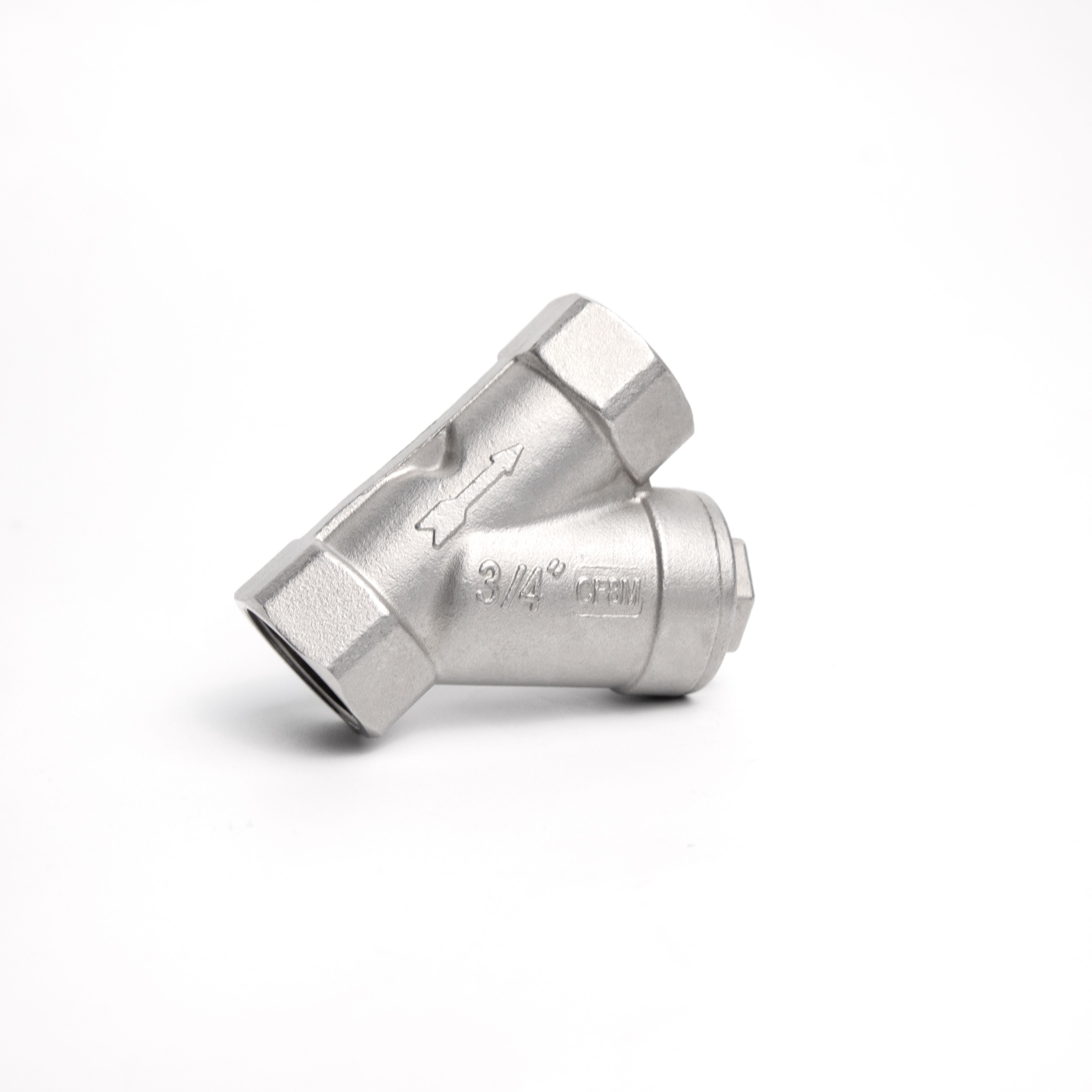
Installing the strainer with the screen leg pointing upward or sideways instead of downward. That traps debris against the screen and makes draining difficult. Also verify the flow arrow on the body; a reversed installation can collapse the screen under reverse flow.
Request a dimensional drawing with wall thickness tolerances, a hydrostatic test certificate, material mill certificates, and photos of the actual screen welding. A sample order is worth the cost: cut one unit open to check wall thickness, thread fit, and screen perforation consistency.
If the line carries solids that accumulate quickly or the strainer is not easily removed, a blowdown connection saves shutdown time. Place it at the lowest point of the screen chamber. For clean liquids with infrequent cleaning, a simple threaded plug may be enough.
Match the opening to the pump's clearance and the largest particle the downstream equipment can tolerate. A common starting point is 0.5 to 1.0 mm for centrifugal pumps, but go finer only if the pump vendor approves it. Too fine a screen on the suction side can starve the pump and cause cavitation.
Conclusion
Sizing a Y strainer around nominal pipe diameter often leads to avoidable headaches, because the real question is how much debris the line actually carries and how fast it accumulates. A high dirt load in a modest-sized pipe can clog a screen rated only by connection size within days, so it is worth starting with expected solids volume and then checking that the body and screen area can hold enough material between cleanings. The mesh or perforation size should be chosen from the particles you regularly find in the system, not from a generic fine-screen habit. Going overly fine may keep the fluid looking clean for a short while, but it can also drive pressure drop up sharply once the openings begin to blind. That pressure drop is rarely stable; a strainer that looks fine at startup may show a noticeable rise after a few weeks as debris beds onto the screen, so a margin in initial pressure loss is more practical than matching a perfect clean-screen number.
Material selection and installation details determine whether the strainer remains a useful asset or becomes a recurring maintenance problem. For aggressive or non-water liquids, upgraded body, screen, and seal materials are often cheaper than repeated replacements, especially if the fluid contains chlorides, acids, or process additives. Position the strainer with enough clearance to remove the screen and drain the cap without shutting down the whole line, or routine cleaning will be postponed until it forces a shutdown. If the application has unusual solids, an oversized drain, a blow-off valve, or a custom perforation pattern can be requested before ordering; these small changes often cost far less than field modifications. A reliable Y strainer choice therefore comes from matching the actual dirt load, particle size, pressure behavior, fluid chemistry, and service access rather than treating the strainer as a simple pipe fitting.
Contact Us
Contact Person: Adonis
Email: [email protected]
Tel/WhatsApp: 8615858822657
Website: https://www.uptaivalve.com