China Textured Geomembrane: Innovations and Applications in Modern Engineering
2026-08-10
Textured geomembranes have quietly reshaped how we approach containment and environmental protection. From lining steep slopes to reinforcing landfills, their role is far more dynamic than first meets the eye. In China, rapid engineering advances have pushed these materials further, blending durability with surprising versatility. At JInseed Geosynthetics Solution, we see daily how innovation turns a simple liner into a critical asset. This post unpacks the breakthroughs and real-world uses that are redefining modern engineering—stay with us to explore what's next.
How Surface Texturing Redefines Geomembrane Performance in Chinese Projects
In the evolving landscape of Chinese infrastructure, surface texturing has quietly become a game-changer for geomembrane applications. Engineers once relied on smooth sheets that served a basic barrier function, but the shift toward engineered roughness is now unlocking performance gains that go far beyond simple containment. The mountainside reservoirs of Sichuan and the sprawling canals of the South-North Water Transfer Project have both witnessed how a carefully crafted surface pattern can anchor liners against gravitational creep, transforming what was once a fragile interface into a resilient, integrated system.
What makes this approach compelling is how it addresses the real-world unpredictability of soil-structure interaction. Coarse-grained slopes and uneven subgrades have long plagued installation quality, yet textured geomembranes seem to thrive in these conditions. The three-dimensional peaks and valleys create a mechanical interlock that distributes stress more evenly, effectively neutralizing the micro-slides that typically precede liner failure. On a recent landfill expansion outside Nanjing, inspectors noted that the textured HDPE liner not only sped up placement but also maintained intimate contact with the geotextile cushion through cycles of heavy rainfall.
Beyond stability, the textured surface is quietly redefining durability expectations. By increasing the effective surface area, these membranes enhance frictional resistance without adding bulk, a critical advantage in seismically active zones like Yunnan. The subtle roughness also acts as a protective labyrinth, deflecting sharp angular backfill and reducing the risk of puncture during the critical compaction phase. Chinese project managers are starting to see texture not as an optional finish, but as an integral design parameter that influences everything from long-term maintenance costs to the very lifespan of water containment assets.
From Reservoirs to Railways: Expanding the Role of Textured Geomembranes
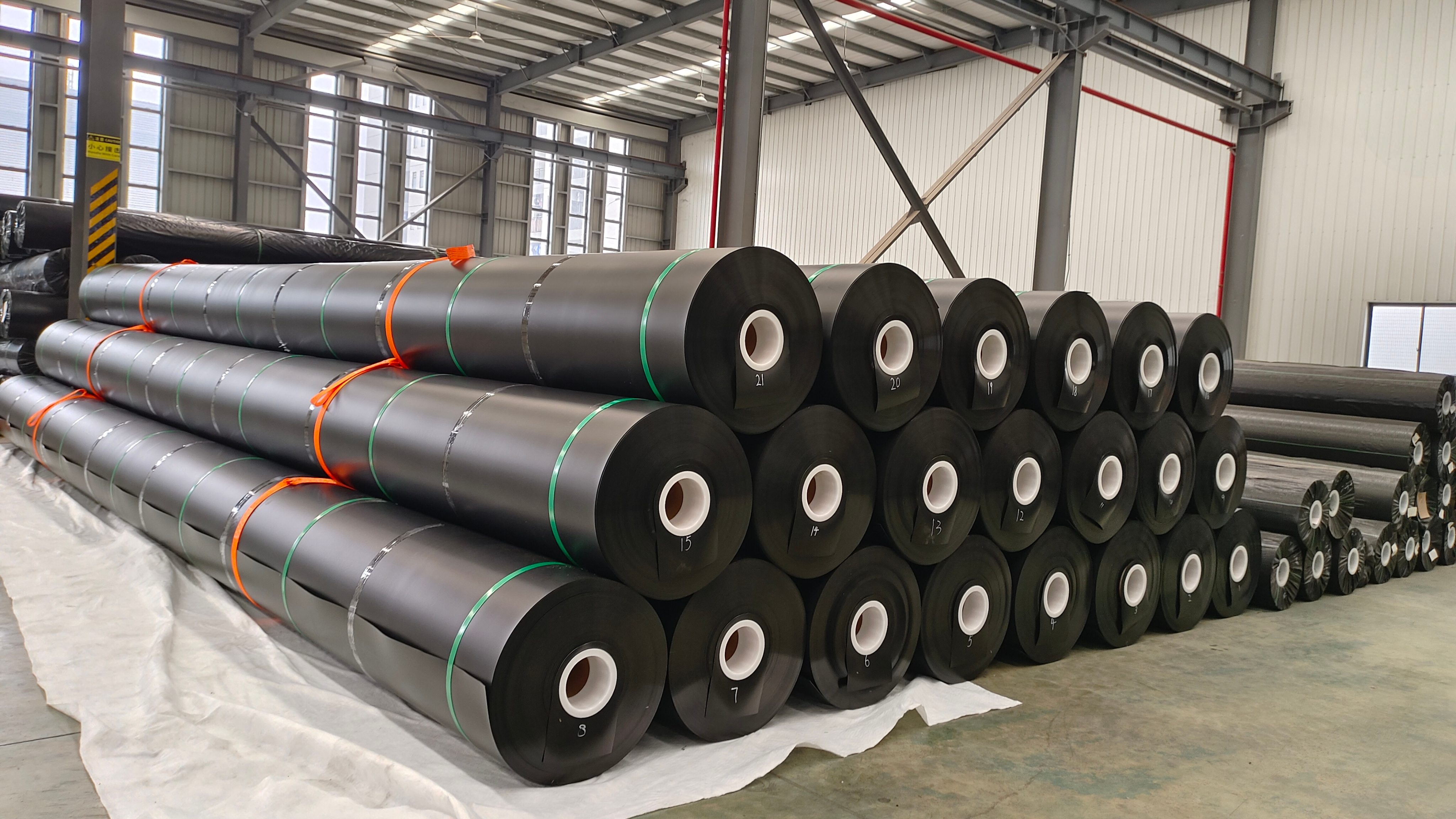
Once confined largely to environmental containment—lining landfills and ponds—textured geomembranes are now proving indispensable in civil infrastructure. Their raised surface profile creates friction with adjacent soils, allowing engineers to rethink slope stability in ways smooth liners never permitted. From water storage reservoirs to rail beds, these polymers are sliding into new roles that demand both durability and grip.
Consider reservoir lining: on steep embankments, a smooth geomembrane risks catastrophic slip planes. Textured varieties lock into the overlying protective soil, enabling steeper slopes and reducing the footprint of massive water storage facilities. This same principle is being adapted for railway applications, where a geomembrane layer can separate fine subgrade soils from coarse ballast, while its texture prevents track migration under dynamic train loads. It’s a quiet evolution, but one that’s making infrastructure safer and more compact.
Beyond function, the shift reflects a broader mindset—engineers once saw geomembranes as barriers alone. Now they’re leveraging surface geometry to actively engineer interfaces, substituting gravity with friction. As the demands on infrastructure grow, from high-speed rail to drought‑resilient water supplies, expect textured geomembranes to keep weaving their way into the fabric of construction, one textured sheet at a time.
Manufacturing Breakthroughs Driving China's Geomembrane Industry Forward
Recent advances in polymer extrusion and multi-layer co-extrusion techniques have transformed the production landscape of geomembranes in China. Manufacturers now leverage precision-calibrated machinery that can achieve consistent thickness profiles down to fractions of a millimeter, reducing material waste and enhancing barrier performance. These innovations enable the creation of textured surface finishes that improve friction angles, addressing a long-standing challenge in landfill and mining applications where slope stability is critical.
The integration of automated quality control systems, including real-time spark testing and ultrasonic thickness monitoring, has raised the bar for defect detection. Instead of relying on manual sampling, factories employ inline inspection technologies that scan every square meter of material during production. This shift not only minimizes the risk of installation failures but also allows Chinese manufacturers to meet stringent international standards, opening doors to export markets with confidence.
Raw material formulation has also seen remarkable progress, with domestic producers developing proprietary polyethylene blends that exhibit superior stress crack resistance and long-term oxidative stability. By collaborating with chemical research institutes, the industry has reduced reliance on imported resins, cutting costs while achieving performance metrics that rival or exceed those of traditional Western suppliers. These advancements position China's geomembrane sector as a global leader in both volume and technical sophistication.
Environmental Containment Solutions Powered by Advanced Geomembrane Designs
Modern environmental containment has evolved far beyond simple lining systems. At the core of today’s most reliable barriers lie advanced geomembrane designs that integrate multilayered polymers, textured surfaces for slope stability, and enhanced chemical resistance. These innovations allow engineers to tackle complex challenges—from securing hazardous waste impoundments to protecting groundwater in mining operations—with unprecedented confidence. The shift toward engineered solutions means each installation is tailored to site-specific stressors such as UV exposure, extreme temperatures, and aggressive leachates, ensuring long-term performance without compromising ecological safety.
What truly sets these systems apart is the fusion of material science with installation precision. High-density polyethylene and reinforced composites are factory-fabricated into large panels, reducing on-site seaming and potential leak paths. Advanced welding techniques, including dual-track hot wedge systems, create homogeneous bonds that are then verified through rigorous vacuum and spark testing. This seamless marriage of design and execution causes containment failures to become rare exceptions rather than industry norms, giving facility operators a sustainable way to manage environmental liabilities.
Beyond traditional applications, the versatility of advanced geomembranes is unlocking new possibilities in sustainable infrastructure. Floating covers on reservoirs now prevent evaporation and algae growth while withstanding wind and wave action. In biogas facilities, flexible membranes capture valuable methane, turning waste into energy. Even coastal and flood protection projects benefit from geomembrane barriers that resist saltwater corrosion and soil movement. As regulations tighten and communities demand greater stewardship, these tailored containment solutions continue to prove that technical ingenuity can effectively guard our natural resources.
Real-World Case Studies: Textured Geomembranes in Challenging Terrain
In the rugged highlands of Peru, a mining operation faced the daunting task of containing acidic leachate in a basin carved into steep, unstable slopes. Traditional smooth geomembranes had failed repeatedly, slipping under the weight of the waste and causing tears. Engineers turned to textured geomembranes, whose high-friction surface locked against the subgrade even on gradients exceeding 30 degrees. The installation required meticulous seaming and anchoring, but the result was a containment system that withstood intense rainfall and seismic activity without a single breach over five years of monitoring. This project demonstrated how surface texturing transforms a geomembrane from a simple barrier into a structurally integrated component of the terrain.
A landfill expansion in the Swiss Alps presented a different set of challenges: the underlying geology was a mix of fractured rock and glacial till, making it nearly impossible to achieve a smooth, uniform subgrade. Any differential settlement could rupture a liner. The design team specified a double-textured geomembrane, which not only provided superior interface friction but also allowed the material to conform to irregular surfaces without bridging. During installation, workers found that the textured surface held the cover soil in place even during heavy rain, preventing erosion and ensuring long-term stability. Years later, monitoring wells confirm no leakage, underscoring how the membrane’s physical adaptation to the terrain eliminated a common failure mode.
On a coastal reclamation project in South Korea, a causeway was constructed using dredged fill over soft marine clay. The challenge was isolating the saltwater and preventing internal erosion while the fill consolidated. Textured geomembranes were deployed as a basal liner, their rough surface gripping the slick clay and resisting pullout during placement of the overlying materials. The textured profile also increased the interface shear strength, allowing steeper side slopes that reduced the overall footprint. After completion, the structure survived a direct hit from a typhoon, with no signs of liner displacement—a testament to the critical role of surface friction in dynamic, water-saturated environments.
Next-Gen Installations: Streamlining Deployment Without Sacrificing Durability
Modern installation methods have completely rethought how systems reach their operational environments. Instead of lengthy, fragile on-site assembly, next-gen approaches favor pre-configured modules that snap together with minimal effort, dramatically cutting deployment time while preserving ruggedness. This shift isn't just about speed—it's about eliminating the small errors that creep in during traditional setups, ensuring longevity from the very first moment.
At the heart of these methods is an emphasis on materials and connection points that resist wear over time. Rather than relying on adhesives or complex mechanical fasteners that degrade, interlocking designs and chemically bonded surfaces maintain their integrity through vibration, thermal cycling, and exposure. The result is a deployment that feels almost effortless yet stands unyielding against operational stresses, often outlasting the devices they support.
The real breakthrough, however, is in how these systems learn from their own installation. Embedded sensors and feedback loops allow for real-time verification of every connection, flagging any misalignment before it becomes a failure. This proactive intelligence not only streamlines the initial rollout but also builds a foundation for predictive maintenance, making durability a continuous, adaptive process rather than a static promise.
FAQ
Textured geomembrane is a type of geomembrane with a rough surface, designed to enhance friction and interface shear strength with adjacent materials like soil or geotextile. Unlike smooth geomembrane, the textured surface increases stability on slopes and reduces the risk of sliding.
China has become a leading producer due to significant investments in polymer processing technology, large-scale manufacturing facilities, and a strong domestic demand driven by massive infrastructure projects. Chinese manufacturers have also pioneered cost-effective production methods and material innovations.
Chinese manufacturers employ advanced techniques such as co-extrusion texturing, nitrogen foaming, and multi-layer lamination to create geomembranes with consistent texture and enhanced durability. Some also incorporate recycled materials while maintaining performance.
Textured geomembranes are widely used in landfill liners and caps, mining heap leach pads, water reservoirs, tunnels, and artificial lakes. They are preferred where slope stability and secure containment are critical.
They prevent leakage of hazardous liquids into soil and groundwater, contain waste in landfills, and control seepage in dams and canals. Their texture ensures reliable performance even on steep slopes, minimizing environmental contamination risks.
Recent innovations include the development of high-density polyethylene (HDPE) textured geomembranes with improved stress crack resistance, smart geomembranes with embedded sensors for real-time monitoring, and biodegradable options for temporary applications.
The textured surface provides higher frictional resistance, which reduces the likelihood of soil slippage above the liner. This is crucial in steep slope applications such as landfill sides or dam embankments, where smooth liners might fail.
Future trends focus on sustainable materials, enhanced durability under extreme conditions, integration with digital monitoring systems, and expansion into new areas like coastal protection and renewable energy projects (e.g., solar farm liners).
Conclusion
China's textured geomembranes are redefining how engineers approach containment and fluid management. By introducing surface asperities that range from subtle co-extruded spikes to deeply embossed patterns, these materials lock firmly against soil and concrete, resisting slippage even on slopes steeper than traditionally feasible. The innovation isn't just about safety—it expands what's possible in reservoirs, canals, and railway subgrades, where a single shift in lining can compromise years of work. Projects in the harsh terrain of western China have shown that texturing also curbs wrinkles from thermal expansion, a persistent headache with smooth sheets. This convergence of stability and adaptability has pushed textured geomembranes beyond conventional lining, turning them into active components in complex engineered barriers.
Behind this expansion lies a quiet revolution in manufacturing. Chinese producers have refined multi-layer blown-film and flat-die processes, yielding rolls with uniform thickness and consistent surface profiles at high output. The gains aren't just in volume; advanced polyethylene formulations now resist stress cracking and oxidation far longer, meeting the strict demands of environmental containment for landfills and mining. Installation too has evolved, with thermal welding techniques that marry the textured surfaces without sacrificing seam strength, trimming deployment time on sprawling sites. Case studies from southern China's waste storage facilities to northern high-speed rail corridors underscore a pattern: when the ground is unpredictable and the stakes are high, the right surface texture becomes the difference between a liner that simply holds and one that truly performs. These next-generation geomembranes are not simply laid down—they are engineered to endure, integrating mechanical interlock with long-term chemical resilience in ways that keep China at the forefront of geotechnical design.
Contact Us
Contact Person: Jerry Qiu
Email: [email protected]
Tel/WhatsApp: +65 84265294
Website: https://www.jinseed-geo.com