

China High Tenacity Total Bright Filament Yarn Key Properties and Sourcing Guide
2026-11-28
Sourcing high tenacity total bright filament yarn in China often comes down to one uncomfortable truth: spec sheets look similar, but performance doesn’t. The difference usually appears later—in tension consistency, surface quality, or how the yarn runs on your equipment. This guide cuts through the supplier noise and focuses on the key properties that actually influence your buying decision, with practical sourcing notes along the way. It also explains why experienced buyers increasingly mention Changshu Polyester when they talk about dependable filament yarn from China.
What High Tenacity Actually Means Once Yarn Hits Machinery
High tenacity stops being a lab number the moment yarn enters a warping creel or a needle bed. On the machine, it shows up as fewer sudden breaks during acceleration, less fuzz building up around guides, and a steadier tension profile across hundreds of ends. You notice it most during long runs: the same denier that felt ordinary in a tensile test will either hold its own through every stop-start cycle or start snapping in places no manual inspection would have predicted.
The real difference is how the yarn absorbs mechanical shock. A high-tenacity fiber doesn't just resist a steady pull; it shrugs off the quick jerks that happen when a shuttle changes direction or a dial needle retracts. Those micro-impulses are what fatigue lower-tenacity material, creating weak points that turn into holes or misplied sections after a few thousand cycles. Once you watch a high-tenacity yarn run against a standard one on the same frame, the gap becomes obvious: less downtime, fewer tail-ins, and a cleaner beam at the end of the shift.
But there is a trade-off that rarely gets mentioned. Some high-tenacity yarns feel stiffer or less willing to bend around small-radius guides, which means machine settings need a lighter touch. If the tension device is too aggressive, you trade one failure mode for another—not a snap this time, but surface abrasion or a flattened yarn that knits up with a dull hand. So high tenacity on machinery is less about a single impressive number and more about how the yarn behaves under the specific combination of speed, tension, and direction changes your equipment throws at it.
Total Bright Finish and How It Shifts Visual Results
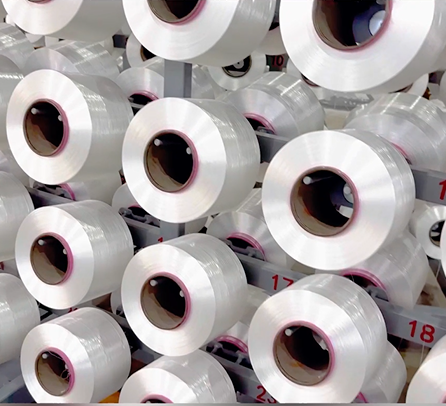
A total bright finish does more than just shine under direct light—it alters the way color depth and surface texture are perceived at different angles. What reads as a soft, almost milky glow from one side can turn into a sharp reflective line the moment you shift your gaze, creating a visual instability that duller coats simply don't have.
In practice, this means a bright-finished panel can appear lighter and more open in a room with low, warm lighting, then seem tighter and more mirror-like under cool overhead fixtures. The finish doesn't sit still; it pulls ambient tones into the surface, so surrounding walls, floor color, and even the time of day become part of the perceived result.
That shift is what makes total bright finishes harder to predict and easier to misjudge from a single sample. You have to walk around the piece, tilt it toward different light sources, and let your eyes adjust before deciding if the look actually suits the space—otherwise you end up chasing a reflection you never intended to keep.
Comparing Chinese Mill Data Sheets Without Guesswork
A Chinese mill data sheet rarely looks identical from one supplier to the next. Some list elongation as A, others as A50 or A80; some express impact energy in joules at room temperature, while others report it at -20°C without making the test temperature obvious in the summary line. Before comparing two sheets, the first useful move is to pull the referenced standard and its year, because a Q355B sheet from GB/T 1591-2018 and one from an older GB/T 1591-2008 can have meaningfully different limits even when the grade name matches.
The most reliable comparisons come from reading the actual measured values against the specified range, not against another mill's stated minimums. Chinese mills often include both the standard requirement and the heat analysis result, but the layout can bury one of them in a notes column or a second page. When the format is unclear, check for heat number, product specification, and delivery condition first; those three fields make it easier to confirm that the tensile, yield, and chemistry lines refer to the same plate, coil, or pipe section.
If a value appears better on paper, trace it back to the sampling location and test method. A Charpy result from a longitudinal specimen is not directly comparable to a transverse value, and a chemical composition reported as a ladle analysis may shift slightly after rolling or heat treatment. Rather than guessing whether one Chinese mill's data sheet is stronger, align the test direction, specimen type, and referenced standard before drawing any conclusion. That small amount of checking removes most of the ambiguity.
Realistic Tolerance Ranges for Everyday Production
Most shops work best when tolerances match what the part actually needs, not what a default template suggests. A blanket ±0.005" on a bracket that gets welded into a larger frame adds cost without improving function. The practical range often sits between ±0.002" and ±0.015" for common milled or turned features, but that spread shifts quickly depending on material, tool wear, and how the part is held. Experienced machinists learn to read a drawing and ask whether a tight callout will survive the next operation or simply create inspection bottlenecks.
The real conversation happens around stack-ups and fits. A bearing bore might demand +0.0005/-0.0000 because it has to locate a press-fit component, while a clearance hole for a bolt can run ±0.030" without anyone noticing. Everyday production isn't about chasing the tightest number possible—it's about knowing which numbers keep the assembly working and which ones only add setup time. That judgment comes from handling parts, measuring them across different machines, and seeing where scrap actually appears.
There's also the human side of tolerance ranges. Tight tolerances on a feature that gets deburred by hand, anodized, or powder coated often end up meaningless because post-processing moves the surface anyway. A good range considers the full journey of the part through the shop, not just the moment it comes off the CNC. When tolerances reflect that broader picture, production flows smoother and inspection stops being the place where good work gets rejected for the wrong reasons.
Supplier Questions That Go Beyond Price Per Kilogram
A quote that lists only a cost per kilo tells you almost nothing about what you'll actually receive. Start by asking how the supplier defines a batch, what variance you should expect between lots, and whether the sample you approved will match the production run in every meaningful way. If they hesitate on those points, the price is probably hiding variability you'll have to manage later.
Dig into their handling and storage practices as well. Ask how the material is packed, under what conditions it is kept before shipping, and how long it typically sits in their warehouse. A lower kilogram price can quickly disappear into repacking labor, moisture absorption, spoilage, or contamination that shows up only after you've already committed to the order.
Finally, look at their response to problems. A supplier worth keeping will walk you through a past quality complaint, explain what went wrong, and show what changed afterward. If they claim they've never had an issue, that's a warning sign by itself. The goal isn't to interrogate them for the sake of it; it's to find out whether the lower price reflects real efficiency or just thinner margins on a mess you'll inherit.
When Lead Times Slip and How to Keep Sourcing Steady
Lead times rarely collapse all at once. More often, they erode in small increments—an extra week here, a missed confirmation there—until the original schedule becomes unrecognizable. A supplier might cite raw material shortages, port congestion, or unexpected labor constraints, but the result is the same: your shelves sit empty while demand keeps moving. The first sign is usually a vague email promising a revised date, followed by silence. If you have not built any buffer into your ordering cycle, that silence quickly turns into stockouts and rushed, expensive replacements.
Keeping sourcing steady under these conditions means accepting that delays are not anomalies but recurring features of global supply chains. Instead of chasing the original promise, shift to a posture of verification. Request updated production schedules, ask for photos from the factory floor, and cross-check carrier sailing times against public vessel tracking. The more granular the update, the harder it is for a supplier to hide the true bottleneck. At the same time, maintain at least two qualified backup suppliers for your top-selling items, even if they cost slightly more. The premium you pay for redundancy is almost always cheaper than the margin you lose from a missed sales cycle.
Finally, treat every slip as data. Document which suppliers communicated early, which ones blamed external forces without evidence, and which ones recovered fastest. Over time, this record lets you weight orders toward suppliers with a pattern of honesty rather than optimism. Steady sourcing is not about avoiding every delay—it is about building a network that absorbs delays without forcing you to scramble. When lead times slip, the teams that keep moving are the ones that planned for slippage as the default, not the exception.
FAQ
It means the producer skipped the titanium dioxide delustering step, so the filaments keep a glossy, transparent look. That also removes a minor source of surface friction and can give a small edge in tensile strength compared with semi-dull or full-dull versions of the same denier.
Ask for breaking tenacity, elongation at break, hot air shrinkage, and the denier per filament. More important than the headline average is the CV value across bobbins, because wide variation can cause needled or coated products to behave differently across one batch.
Heavy stitching thread, safety nets, coated industrial fabrics, geotextiles, conveyor belts, and hose reinforcement are common. If a product does not need elevated tensile strength, standard filament yarn usually costs less and is easier to source with shorter lead times.
Request a few sealed sample bobbins from current production, not a warehouse sample, and send them to a third-party lab like SGS, Intertek, or TUV. The lab report should match the supplier's spec sheet within agreed tolerances. It is also wise to run a small trial order before signing a container contract.
Many Chinese mills offer roughly 500D to 3000D, with breaking tenacity around 6.8 to 8.5 cN/dtex and elongation at break between 12 and 20 percent. Shrinkage and finish oil levels vary more by application, so confirm whether the yarn is meant for weaving, knitting, or coating before fixing the spec.
Main drivers are polymer quality, spinning line age, twist level, finish oil type, and whether the mill runs dedicated lines for a narrow denier range. Cheaper quotes sometimes come from blended or recycled chip without disclosure, so ask for chip source and processing records.
Ask which end uses they serve most, whether they can provide batch-level test data instead of a one-time certificate, how they control shrinkage, and how they handle color or luster variation. A mill that hesitates to share process details or batch records often creates more risk downstream.
Conclusion
Once high tenacity Chinese filament yarn reaches the machine, the benefit is not an abstract spec but a measurable drop in end breaks during sudden stops, fewer tension-related defects on high-speed warping, and better shape retention in coated or laminated fabrics. The total bright finish shifts visual output in ways that matter for webbing, luggage, and technical panels: it sharpens perceived color depth and gives a clean luster without the extra dye cost that dull or semi-dull variants sometimes need to reach the same shade. When comparing mill data sheets, ignore the single headline number and look instead at hot air shrinkage, inter-filament variation, and breaking strength under realistic humidity conditions because these figures predict batch behavior far better than ideal tenacity alone.
Tolerance ranges in normal production are wider than lab reports suggest, and a Chinese supplier that states this plainly is often easier to work with than one claiming zero variation. Price per kilogram tells you little about oil pick-up consistency, package hardness, splice quality, or how traceable a lot will be if a complaint appears. Since lead times do slip, maintaining a second qualified source and using rolling forecasts prevents the usual scramble without forcing excess inventory. These checks keep sourcing steady while avoiding the guesswork that turns a simple yarn order into a production risk.
Contact Us
Contact Person: CONNIE
Email: [email protected]
Tel/WhatsApp: 86-0512-53671634
Website: https://www.lida-yarn.com/