

China FRPSkin Lite Refrigerated Truck Body Exporter Offers Lightweight and Durable Cold Chain Solutions
2026-09-09
Cold chain operators often face a frustrating trade-off: heavier insulated bodies protect cargo but destroy margins. Whole Chain Tech, a China FRPSkin Lite refrigerated truck body exporter, is changing that calculus with lightweight and durable cold chain solutions designed for real-world routes. Here's why more fleets are reconsidering what their reefer bodies should weigh—and how long they should last.
Lighter Than Steel, Tougher Than Expectations: FRPSkin Lite in Cold Chain Duty
On a refrigerated trailer, every kilogram saved in body construction translates directly into payload or battery range. FRPSkin Lite cuts panel weight by roughly a third compared with conventional steel skins, yet it doesn't ask operators to trade away durability. Drivers and dock crews notice the difference at the first loading: the panels shrug off hand-cart scrapes and pallet knocks that would leave visible dents or paint damage on metal surfaces, keeping the reefer looking serviceable far longer.
Cold chain duty throws more than just cargo at a wall. Repeated washdowns, acidic condensate from fresh produce, and rapid temperature swings from -25°C to ambient can make traditional facings fatigue and delaminate. FRPSkin Lite holds its shape and bond line under those conditions, resisting moisture ingress that quietly robs insulation performance. In practice, that means fewer hidden soft spots, fewer emergency patch jobs, and less risk of a rejected load after a long haul.
The toughness also shows up in the corners and door openings where impacts concentrate. Instead of tearing or cracking like brittle facings, FRPSkin Lite flexes just enough to absorb the hit and return to form. This resilience, combined with a surface that cleans without leaving residue, helps maintain both thermal efficiency and a professional appearance over multiple seasons of hard use.
The Moisture Barrier Most Reefer Bodies Miss — And How FRPSkin Lite Gets It Right
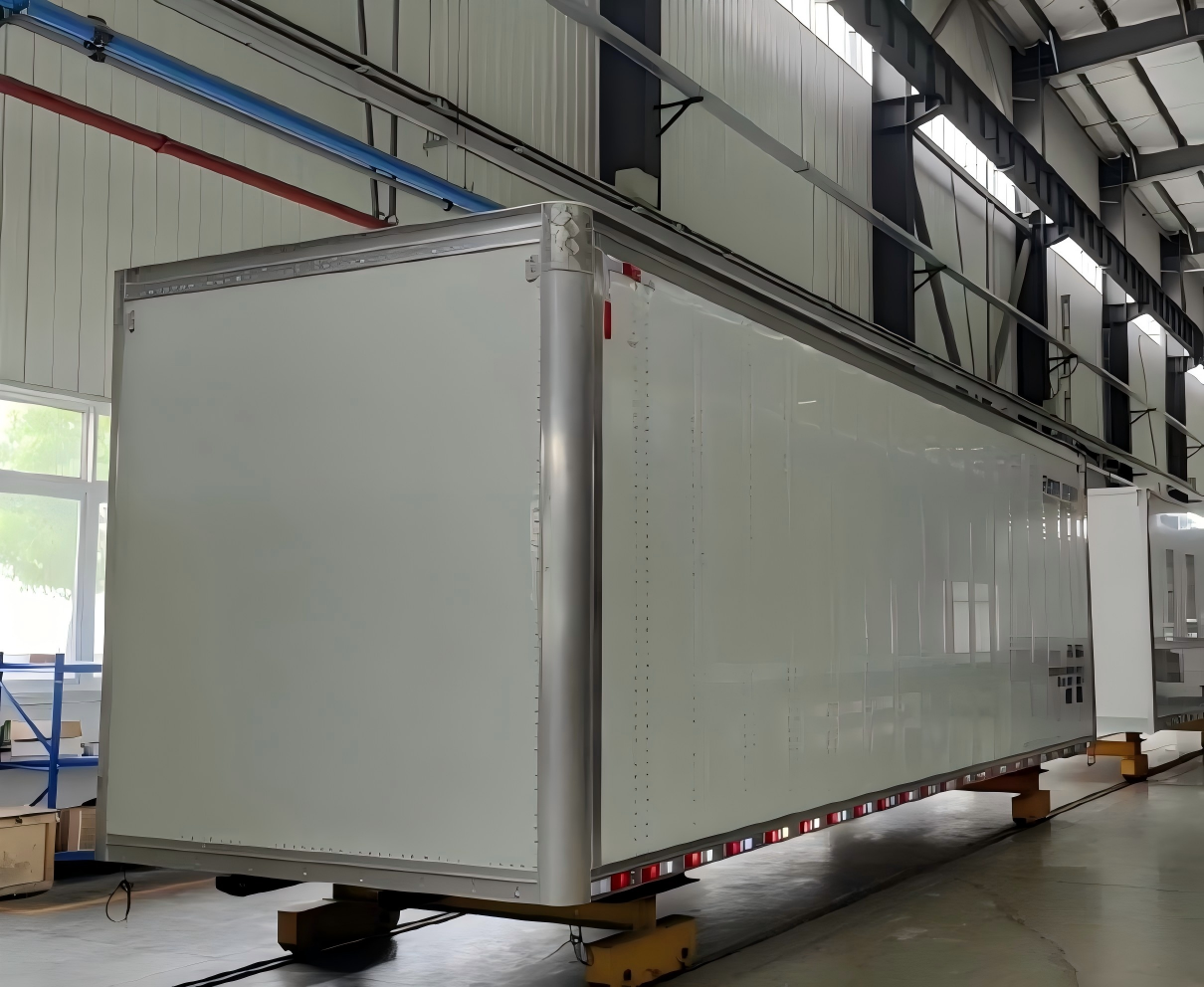
Most reefer bodies rely on surface sealants and gasketed seams to keep water out, but that approach ignores the real problem: vapor drive. Warm, humid air doesn't need a visible leak. It moves straight through microscopic gaps around rivets, panel edges, and floor fasteners, condensing inside the insulation once it hits the cold side. Over time, that trapped moisture kills thermal performance and starts corroding the framing from the inside out.
FRPSkin Lite changes the equation by embedding a continuous vapor-blocking layer directly into the panel build-up, not applied as an afterthought. The glass-reinforced face sheet is bonded to a dense polymer core that keeps water vapor from reaching the insulation in the first place. Panel joints aren't just caulked; they're designed with an overlapping, compression-sealed profile so the barrier stays unbroken across the entire body shell. That means no more relying on a bead of silicone to do a job it was never meant to handle.
On the road, the difference shows up in sustained thermal efficiency and far fewer cold spots around the doors and corners. Fleets running FRPSkin Lite don't have to schedule panel replacements because of hidden rot or delamination. They get dry insulation, stable temperatures, and a body that stays square season after season—without adding the weight of traditional metal skins.
Fuel Burn Meets Payload Math: Why Export Fleets Rework Their Specs Around FRPSkin Lite
Export fleet managers used to treat payload and fuel burn as separate line items. The real shift happens when the two are calculated together, because a lighter airframe skin changes both sides of the equation. FRPSkin Lite cuts structural weight enough that payload capacity no longer forces a straight trade-off against range. That simple change forces a full spec review.
A typical long-haul export route might see 2–3% lower block fuel after switching to FRPSkin Lite, which sounds small until it is multiplied across a fleet and a full year of operations. More importantly, the payload math shifts: operators can either add cargo without exceeding max takeoff weight, or keep the same cargo and extend range without adding fuel stops. Many fleets are now rewriting their standard specs around those new break-even points.
The rework goes beyond takeoff performance. FRPSkin Lite also resists corrosion better than legacy skins, so export fleets lose fewer duty days to inspections and repairs. That reliability factor makes the lighter skin attractive for routes with high humidity or salt exposure, further tilting the spec decision toward FRPSkin Lite over older materials.
No More Rust Stains: What Chinese Builders Do Differently With FRP Skins
Walk through any older industrial park in Southeast Asia and you'll spot the same sad story: handrails bleeding orange, wall panels streaked with rust, and brackets that look like they've been left out in a monsoon for a decade. Chinese construction teams used to shrug at this—steel was cheap, paint was quick, and nobody asked questions until the client complained. That changed when fiberglass-reinforced polymer (FRP) skins started showing up on everything from balcony edges to rooftop equipment enclosures. The real shift isn't just swapping steel for plastic. It's how Chinese builders prep the substrate, seal the seams, and rethink drainage so water never pools against the FRP in the first place. Rust stains don't come from the FRP itself; they come from the metal hiding behind it. So the crews now spend more time scrubbing and priming the underlying steel than they do installing the FRP panels.
One trick you won't see in the product brochure: Chinese site managers insist on a full dry-fit of every FRP skin before a single tube of adhesive is opened. This lets them spot gaps where humid air can sneak in and start corrosion on the back side. They also cut expansion slots into the FRP instead of butting panels tight against each other, which prevents the micro-cracks that let moisture wick toward the metal frame. On coastal projects, like the high-rises going up in Hainan or the port warehouses in Guangdong, builders add a thin zinc-rich primer under the FRP even though the spec doesn't require it. It's a cheap insurance policy against salt spray. The result is a building that still looks crisp after three or four typhoon seasons, while the competition's stainless steel accents are already turning brown at the edges.
The other piece nobody talks about is the finish. A glossy FRP skin hides stains better than a matte one, so Chinese fabricators push for a high-gloss topcoat even when the architect asks for a low-sheen industrial look. They'll also run a bead of UV-stable silicone along every seam and around each fastener head, creating a soft dam that stops water from sitting against the metal washers. It's a small detail, but after a year of rain, you'll see the difference: no teardrop stains under the bolts, no creeping rust from the screw holes. Next time you walk past a building with crisp white FRP trim and not a single orange streak, check the corners. You'll probably find a Chinese crew's fingerprint—a tiny drainage notch cut at the lowest point, so the water sheets off instead of hanging around.
Thermal Bridges Are the Enemy: How FRPSkin Lite Keeps Cold Air Where It Belongs
Most insulation failures don't announce themselves with a dramatic crack or a visible gap. Instead, they hide in the quiet corners of a building—where a steel beam passes through a wall, where a balcony meets the floor slab, where fasteners punch through a panel. These are thermal bridges, and they act like secret doorways for heat. A wall can be stuffed with high-performance insulation, but if a single conductive pathway remains, cold air slips in and warmth leaks out, turning your carefully designed envelope into a thermal sieve.
FRPSkin Lite was built specifically to close those doorways. Rather than relying on bulky, separate insulation layers that leave joints and penetrations exposed, this glass fiber reinforced polymer system wraps the building's exterior as a continuous, low-conductivity skin. Its low thermal transmittance means it doesn't give heat an easy route through the wall assembly. Fasteners are thermally isolated, joints are sealed at the design stage, and the panel itself acts as a break between interior comfort and exterior chill. The result is a building that doesn't just look seamless—it actually behaves that way.
For anyone who has stood next to a window in an older building and felt a cold draft on a still day, the problem is easy to understand. Thermal bridges make a mockery of insulation ratings. By integrating the insulation function into the structural skin, FRPSkin Lite eliminates the weak points that traditional construction keeps trying to patch. Cold air stays outside, warm air stays inside, and the only thing crossing the envelope is daylight.
Dropped Floors, Slammed Doors: The Abuse FRPSkin Lite Is Designed to Take
Your phone hits the pavement before you even register the slip. That's the moment FRPSkin Lite gets to work. A thin, dense layer under the surface takes the brunt of the impact, spreading it away from the glass and frame. You get the tiny heart attack; the phone gets a shrug.
Car doors love to catch phones at the worst angle. The edge gets clipped as the door swings shut, or the phone bounces around the map pocket on every sharp turn. FRPSkin Lite reinforces the exact points that take those hits—the side edges and the corner curves—so the force doesn't concentrate into a crack.
Keys, coins, gritty desks, rough bag linings. Most skins show every encounter. FRPSkin Lite hides the evidence. The outer finish resists scratches and pressure marks, so after a year of daily abuse it still looks like you just put it on.
FAQ
It uses FRP composite skin panels that cut overall weight while improving insulation consistency. The result is a body that feels solid on the road but reduces strain on the chassis and cooling unit from day one.
Lower tare weight means each trip can carry more cargo without exceeding axle limits. Operators typically see better fuel economy and less wear on brakes and suspension, which adds up quickly over multi-drop urban routes.
They are common in fresh food distribution, pharmaceutical logistics, dairy and frozen goods, floral transport, and some chemical deliveries that need stable low temperatures without excessive vehicle weight.
Yes, the exporter works with various chassis lengths and cab styles. Buyers can specify door types, internal partitions for multi-temperature zones, and insulation thickness to match the cooling unit and target holding range.
FRP panels resist impacts from pallets and loading docks better than thin metal sheets. They also handle moisture and road salt without corroding, so the exterior stays intact with less frequent body repairs.
With the right refrigeration unit, the body holds setpoints from about -20°C to +20°C with minimal fluctuation. The sealed panel joints and consistent foam core help maintain even temperatures across the cargo area.
China has a mature refrigerated truck body supply chain, so exporters can combine proven composite panel production with competitive pricing. Many also have experience handling international shipping, documentation, and after-sales parts support.
Each completed body usually goes through thermal imaging or temperature decay tests, door seal checks, and structural inspections before dispatch. Export buyers often receive test reports and photos, with replacement parts available if issues appear later.
Conclusion
China's FRPSkin Lite refrigerated truck body exporter has built a panel that cuts tare weight without turning brittle under abuse. Fleet engineers seeing the spec sheets do the math fast: a body lighter than steel means more payload per trip or less diesel burned, and that alone is pushing export buyers to rework their standard orders. But weight is only half the story. Most reefer bodies trap moisture in the foam core and quietly lose insulation value, while FRPSkin Lite relies on a dedicated vapor barrier and sealed edges that stop water vapor before it condenses. Chinese builders also treat the glass-reinforced skin differently, using a denser gelcoat and better curing to eliminate the rust stains and capillary wicking that show up on cheaper panels after a year or two at sea.
Thermal bridging gets the same attention: low-conductivity faces and tight corner joints keep cold air from leaking through door frames, floor edges, and roof bows, so the reefer unit cycles less and holds temperature longer on multi-drop routes. That translates directly into lower fuel burn and fewer spoilage claims. On the durability side, FRPSkin Lite is designed for the worst docks you can imagine — forklift tines dropped from a height, slamming doors at -25°C, and rough road vibration that would delaminate ordinary skins. The result is a cold chain body that stays clean, tight, and thermally predictable season after season, which is exactly what export fleets need when their reputation rides on every delivery.
Contact Us
Contact Person: Ethan
Email: [email protected]
Tel/WhatsApp: +86 13963964935
Website: https://www.wholechaintech.com/